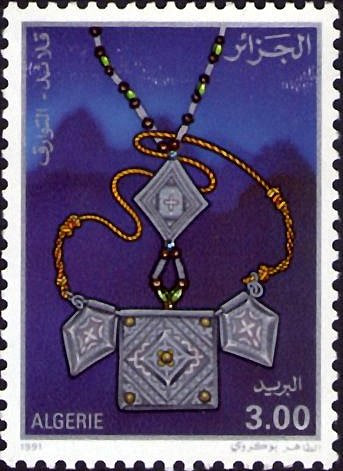
Jewelry from the South (Tuaregs)
Jewelry from the Algerian Sahara can be divided, from a style point of view, into two large sets. The first, that of Hoggar-Tassili, is linked to the traditions of Targuie jewelry which go far beyond the geographical limits of Algeria and infiltrate the territories of Mali and Niger. The second, that of the Saharan Oases (Gourara, Touat, Tidikelt), is related to the style of Mauritanian and Moroccan jewelry.
Today, the geographical limits of wearing different Saharan jewelry correspond less and less to the places of issue or manufacture. Everything is worn by everyone: consumers and especially jewelers know how to recognize the origin.
The stylistic difference arises above all from the manufacturing techniques. Thus, the Targui jeweler mainly uses the technique of molding, incision and punching (in hollow or regrowth), while that of the Saharan Oases uses relief, filigree and shot decoration.
These two technical features are found in the different types of safari jewelry.
The large tera pectoral pendants (singular: teraout), ornaments particularly appreciated by the Targuies, are worked with embossed work. They consist of an assembly of several triangular planar plates, lined with ordinary metal plate, which gives them a certain thickness. The teraout, the centerpiece of the wedding set, is worn hanging around the neck and attached to a leather strap. Pendants of the same type but fitted with a hook are worn as temple adornments and hung on the hair.
The bracelets are of several types: sambarou, large, incised and with a large bulge in the middle; issoghan, having the shape of a thick ring, but hollow inside and decorated with twisted wires and shot; finally, different models of molded bracelets with a solid ring and whose ends end in a cube or a ball.
Tissek rings, very popular with Saharan women, are distinguished by the variety of models in terms of dimensions, shape and manufacturing techniques. Those in the shape of massive twisted rings or with circular bulges and which are also worn as pendants are generally molded. Those with box-shaped bezels, sometimes very large, are planar and decorated with incisions, filigrees or granulations.
If these different types of jewelry are purely decorative objects, there are others whose function is essentially utilitarian. This is the case of a pendant in the shape of a key (assarou n’swoul; veil key). Originally a padlock key, it holds in place the side of the drape thrown over the shoulder. This jewel, which can take a very complex shape, is most often decorated with incisions.
Source: Bardo National Museum.
Today, the geographical limits of wearing different Saharan jewelry correspond less and less to the places of issue or manufacture. Everything is worn by everyone: consumers and especially jewelers know how to recognize the origin.
The stylistic difference arises above all from the manufacturing techniques. Thus, the Targui jeweler mainly uses the technique of molding, incision and punching (in hollow or regrowth), while that of the Saharan Oases uses relief, filigree and shot decoration.
These two technical features are found in the different types of safari jewelry.
The large tera pectoral pendants (singular: teraout), ornaments particularly appreciated by the Targuies, are worked with embossed work. They consist of an assembly of several triangular planar plates, lined with ordinary metal plate, which gives them a certain thickness. The teraout, the centerpiece of the wedding set, is worn hanging around the neck and attached to a leather strap. Pendants of the same type but fitted with a hook are worn as temple adornments and hung on the hair.
The bracelets are of several types: sambarou, large, incised and with a large bulge in the middle; issoghan, having the shape of a thick ring, but hollow inside and decorated with twisted wires and shot; finally, different models of molded bracelets with a solid ring and whose ends end in a cube or a ball.
Tissek rings, very popular with Saharan women, are distinguished by the variety of models in terms of dimensions, shape and manufacturing techniques. Those in the shape of massive twisted rings or with circular bulges and which are also worn as pendants are generally molded. Those with box-shaped bezels, sometimes very large, are planar and decorated with incisions, filigrees or granulations.
If these different types of jewelry are purely decorative objects, there are others whose function is essentially utilitarian. This is the case of a pendant in the shape of a key (assarou n’swoul; veil key). Originally a padlock key, it holds in place the side of the drape thrown over the shoulder. This jewel, which can take a very complex shape, is most often decorated with incisions.
Source: Bardo National Museum.