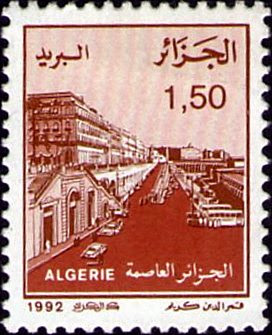
View of Algiers
At the beginning of the 10th century, the central Maghreb had Ziri Ibn Manad as its ruler and Achir, southeast of Médéa, as its capital. Bologhine, son of Ziri, founded three new cities in the second half of the 10th century: Miliana, Médéa and El Djazaïr. Algiers was called Djazaïr Béni Mezghena, Djazaïr, because of the islets which were located offshore and which, connected to the mainland, currently forming the Admiralty Pier. Over the following centuries, Arab geographers and travelers described the activities of El Djazaïr as a merchant city and a prosperous port which undertook commercial exchanges with all the countries of the Mediterranean.
In the 16th century, El Djazaïr became an important metropolis of the Turkish Regency. From then on it was a port and a fortified city. Its enclosure was built by Khayr-Eddine Barberousse and reinforced by his successors. This enclosure was pierced by five doors: BabDzira, Bab L’bhar, Bab El Oued, Bab Azzoun and finally Bab Djedid. Marked by the relief and climate conditions, Algiers is an expanding city which is distinguished by its history.
The Casbah, an architectural masterpiece, is classified as a universal heritage, whose rehabilitation and preservation remain a constant concern. Its monuments are a precious testimony to the Muslim civilization in which modern Algeria draws its roots. Having become the political, economic and administrative capital, Algiers constitutes, through its privileged position, the mirror of the country. Indeed, foreign visitors, when docking at the port, greatly appreciate the panorama which catches the eye characterized by the white color of the buildings. Equipped with an important infrastructure, Algiers is also the seat of several cultural, commercial and sporting events which allow it to contribute to the strengthening of traditional fraternal and friendly ties.
In the 16th century, El Djazaïr became an important metropolis of the Turkish Regency. From then on it was a port and a fortified city. Its enclosure was built by Khayr-Eddine Barberousse and reinforced by his successors. This enclosure was pierced by five doors: BabDzira, Bab L’bhar, Bab El Oued, Bab Azzoun and finally Bab Djedid. Marked by the relief and climate conditions, Algiers is an expanding city which is distinguished by its history.
The Casbah, an architectural masterpiece, is classified as a universal heritage, whose rehabilitation and preservation remain a constant concern. Its monuments are a precious testimony to the Muslim civilization in which modern Algeria draws its roots. Having become the political, economic and administrative capital, Algiers constitutes, through its privileged position, the mirror of the country. Indeed, foreign visitors, when docking at the port, greatly appreciate the panorama which catches the eye characterized by the white color of the buildings. Equipped with an important infrastructure, Algiers is also the seat of several cultural, commercial and sporting events which allow it to contribute to the strengthening of traditional fraternal and friendly ties.