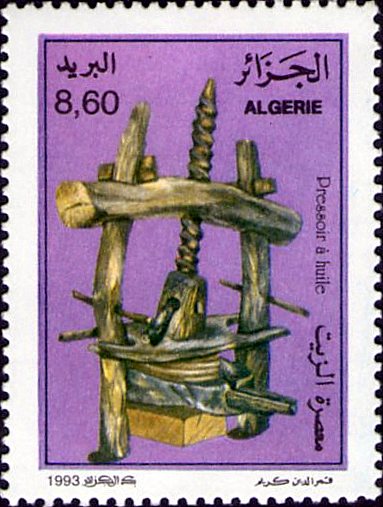
Oil press
Among the vast field of traditions bequeathed by history and time to Algerian society, the means and processes of work are an integral part of the heritage which has continued to be transmitted from generation to generation. In order to meet the needs of man and the community, a whole range of machines and traditional techniques were implemented according to the goods and services essential to the evolution of economic and social life through the ages.
Whether for domestic, social or cultural needs, men have had to deploy treasures of ingenuity to improve the exploitation and expansion of the natural resources at their disposal, in close connection with the scientific knowledge of the time.
This is how man's first vital need, namely food, has generated equipment, tools and methods that have a form and utility as diverse as they are multiple. Also, since ancient times, man, particularly in Algeria, a country known for its cereal traditions, has had to produce and preserve the grain essential for his consumption of flour and bread and that of his livestock.
This is why the grain mill, made up of two stone discs with a central opening through which the grain to be ground is poured and a side handle, still exists in the regions and villages of Algeria. This traditional technique for grinding wheat and then separating the flour and bran was the first used before the advent of mills. But once the harvest period has passed, grinding the grain remains a daily job according to the needs of man who felt the need to preserve, store and protect the precious cereals, the fruit of his work, from loss from bad weather and threats of all kinds. For collective use, he has built grain silos high or underground whose architecture, layout and location meet both the functional needs of daily life and the requirements of protection and conservation of cereals for periods of time until the next harvest.
For daily use, jars with multiple openings are widespread in our regions and make it possible to preserve quantities of grain consistent with rational management of family resources. High or underground, these silos still exist in our country for very limited needs, however.
Another traditional crop in Algeria, the olive tree. He also introduced working tools and techniques both to preserve the olive as a fruit after processing and to use it as a raw material for the production of oil, the uses of which were and still remain well anchored in the social traditions of the country. It is therefore no coincidence that the oil press, made up of wooden parts and for collective use, still spreads across regions and villages where the olive tree remains an appreciable resource for men. The olive press often gives rise to festivals illustrating solidarity between the entire community within the rural world.
Whether for domestic, social or cultural needs, men have had to deploy treasures of ingenuity to improve the exploitation and expansion of the natural resources at their disposal, in close connection with the scientific knowledge of the time.
This is how man's first vital need, namely food, has generated equipment, tools and methods that have a form and utility as diverse as they are multiple. Also, since ancient times, man, particularly in Algeria, a country known for its cereal traditions, has had to produce and preserve the grain essential for his consumption of flour and bread and that of his livestock.
This is why the grain mill, made up of two stone discs with a central opening through which the grain to be ground is poured and a side handle, still exists in the regions and villages of Algeria. This traditional technique for grinding wheat and then separating the flour and bran was the first used before the advent of mills. But once the harvest period has passed, grinding the grain remains a daily job according to the needs of man who felt the need to preserve, store and protect the precious cereals, the fruit of his work, from loss from bad weather and threats of all kinds. For collective use, he has built grain silos high or underground whose architecture, layout and location meet both the functional needs of daily life and the requirements of protection and conservation of cereals for periods of time until the next harvest.
For daily use, jars with multiple openings are widespread in our regions and make it possible to preserve quantities of grain consistent with rational management of family resources. High or underground, these silos still exist in our country for very limited needs, however.
Another traditional crop in Algeria, the olive tree. He also introduced working tools and techniques both to preserve the olive as a fruit after processing and to use it as a raw material for the production of oil, the uses of which were and still remain well anchored in the social traditions of the country. It is therefore no coincidence that the oil press, made up of wooden parts and for collective use, still spreads across regions and villages where the olive tree remains an appreciable resource for men. The olive press often gives rise to festivals illustrating solidarity between the entire community within the rural world.