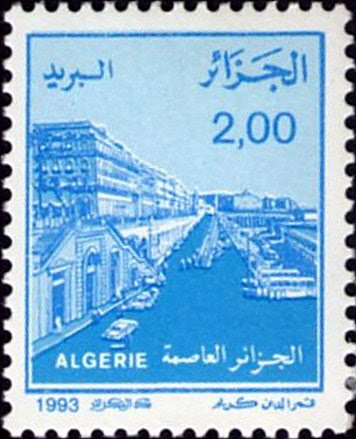
View of Algiers
The lower Casbah was razed in the first years of French colonization, which redesigned and rebuilt the city of Algiers in the image of certain French cities. The El Bahdja waterfront is one of the first witnesses of colonial urbanization. Designed by the architect and painter Frédéric Chassériau, in a style described as neoclassical, it was inaugurated by Napoleon III in 1865.
The grand boulevard which runs along the sea is dressed in the colors of the Mediterranean. The white facades flanked by blue colored frames give the city an identity that it will keep forever. Over nearly 1,500 m, there are arcaded buildings housing the wilaya of Algiers, the Bank of Algeria, the headquarters of the National People's Assembly, the Council of the Nation and the Essafir hotel. The waterfront starts from Port-Saïd Square to the west, running along Boulevard Zighoud-Youcef and continuing onto Boulevard Che Guevara to the east. Below, the Algiers station and further north, the harmonious constructions of the Admiralty stand out, built on the islets from which the name El Djazaïr was taken.
This is where Pedro Navarro built the penon to threaten the city of Algiers. The improvement of this anchorage dates back to the 16th century. It was the dey Khayr-Eddine who, in 1529, after driving out the Spaniards, decided to connect it to the mainland by a pile of natural blocks. The seafront boulevard breaks free from the limits imposed on it and joins the port via a system of impressive ramps. The city opens up to the world through its port which continues to expand.
The grand boulevard which runs along the sea is dressed in the colors of the Mediterranean. The white facades flanked by blue colored frames give the city an identity that it will keep forever. Over nearly 1,500 m, there are arcaded buildings housing the wilaya of Algiers, the Bank of Algeria, the headquarters of the National People's Assembly, the Council of the Nation and the Essafir hotel. The waterfront starts from Port-Saïd Square to the west, running along Boulevard Zighoud-Youcef and continuing onto Boulevard Che Guevara to the east. Below, the Algiers station and further north, the harmonious constructions of the Admiralty stand out, built on the islets from which the name El Djazaïr was taken.
This is where Pedro Navarro built the penon to threaten the city of Algiers. The improvement of this anchorage dates back to the 16th century. It was the dey Khayr-Eddine who, in 1529, after driving out the Spaniards, decided to connect it to the mainland by a pile of natural blocks. The seafront boulevard breaks free from the limits imposed on it and joins the port via a system of impressive ramps. The city opens up to the world through its port which continues to expand.