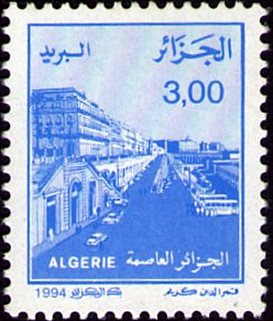
View of Algiers
Facing the blue expanse of the sea, Algiers reveals itself and can be admired. Its mysteries jealously guarded by the Casbah rub shoulders with Western architecture below which aims to give the city a European character straight from Paris. The waterfront and, as an extension, the Grande Poste d’Algiers are there to forge links with the Moorish history of the city.
Imagined by the Governor General of Algiers Charles Célestin Jonnart, appointed in 1903, the architecture was conceived as an initiative to bring together the natives and Europeans, but also as a way of consecrating the success of French colonization. The architectural mix is successful, but the bringing together of communities is only an illusion. The Casbah will continue to house the authentic and stripped-down lifestyle of its people, while the new neighborhoods alongside the port are the scene of a peaceful and upscale Western life.
In his attempt to Arabize public buildings, Governor Jonnart invented the neo-Moorish style which would be the architectural mark of Algiers in the 1900s. The white city usurped the thousand-year-old history of its people despite a half-European, half-Moorish character, however, refused the adoption of the colonizers and kept jealously buried in its memory the customs and traditions of yesteryear. The Casbah will hide its desire for freedom in its mazes to let them fly freely, as soon as the death knell for colonization sounds, from its superimposed terraces.
Algiers, which was to be the symbol of colonial power, will remain, despite attempts at architectural disguise, fundamentally Algerian in its soul. The business of bringing together European and Moorish styles only lasted until the 1920s, the neo-Moorish style ultimately not having succeeded in reconciling European and Arab-Islamic cultures. Different architectural styles were then tried in the city which returned to its own in 1962, beautiful in its diversity and its majestic presence overlooking the sea.
Imagined by the Governor General of Algiers Charles Célestin Jonnart, appointed in 1903, the architecture was conceived as an initiative to bring together the natives and Europeans, but also as a way of consecrating the success of French colonization. The architectural mix is successful, but the bringing together of communities is only an illusion. The Casbah will continue to house the authentic and stripped-down lifestyle of its people, while the new neighborhoods alongside the port are the scene of a peaceful and upscale Western life.
In his attempt to Arabize public buildings, Governor Jonnart invented the neo-Moorish style which would be the architectural mark of Algiers in the 1900s. The white city usurped the thousand-year-old history of its people despite a half-European, half-Moorish character, however, refused the adoption of the colonizers and kept jealously buried in its memory the customs and traditions of yesteryear. The Casbah will hide its desire for freedom in its mazes to let them fly freely, as soon as the death knell for colonization sounds, from its superimposed terraces.
Algiers, which was to be the symbol of colonial power, will remain, despite attempts at architectural disguise, fundamentally Algerian in its soul. The business of bringing together European and Moorish styles only lasted until the 1920s, the neo-Moorish style ultimately not having succeeded in reconciling European and Arab-Islamic cultures. Different architectural styles were then tried in the city which returned to its own in 1962, beautiful in its diversity and its majestic presence overlooking the sea.