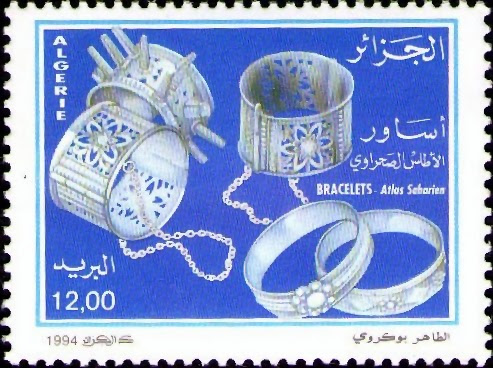
Saharan Atlas Jewelry Bracelets
Crafts faithfully reflect the traditions of peoples and nations. It is the witness par excellence of history, because it is always the result of man's activities in a defined stage of his history and his evolution. It is for this reason, and given the important place that crafts occupy in societies, their historical as well as civilizational role and their economic interest, that the Ministerial Council of the Arab Maghreb Union in charge of Tourism and Crafts recommended, during its meeting of October 24, 25 and 26, 1993, to celebrate annually the Maghreb Crafts Day on October 16.
To mark this event, in 1994, the Algerian Post and Telecommunications Administration decided to issue a series of postage stamps representing jewels from the Saharan Atlas.
The Saharan Atlas, a vast territory where both nomadic and sedentary populations coexisted, presented all the advantages likely to develop the establishment of a rich and prosperous jewelry store. Through their intermittent travels, the jewelers themselves contributed largely to the distribution of their jewelry. But jewelers chose to set up mainly in large centers, such as El Bayadh, Djelfa and Boussaâda where the clientele was large and varied: city dwellers, women from the ksour and douars, as well as nomads passing through.
In these regions, women had a preference for head ornaments, tiaras (mechbek, haslilou), earrings (mcharaf, khorsa), clasps, head pendants and chinstraps, as well as necklaces most often made of coins (cherka and chentouf).
To mark this event, in 1994, the Algerian Post and Telecommunications Administration decided to issue a series of postage stamps representing jewels from the Saharan Atlas.
The Saharan Atlas, a vast territory where both nomadic and sedentary populations coexisted, presented all the advantages likely to develop the establishment of a rich and prosperous jewelry store. Through their intermittent travels, the jewelers themselves contributed largely to the distribution of their jewelry. But jewelers chose to set up mainly in large centers, such as El Bayadh, Djelfa and Boussaâda where the clientele was large and varied: city dwellers, women from the ksour and douars, as well as nomads passing through.
In these regions, women had a preference for head ornaments, tiaras (mechbek, haslilou), earrings (mcharaf, khorsa), clasps, head pendants and chinstraps, as well as necklaces most often made of coins (cherka and chentouf).