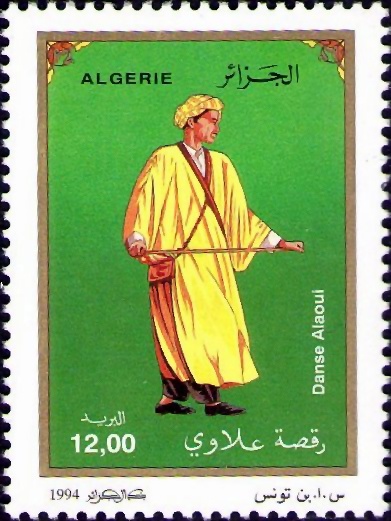
Alaoui Dance
Folklore, which means “science of the people”, plays a determining role in the production, definition and representation of collective identity. Everywhere in Algeria, we go in search of our roots which we find jealously safeguarded among the inhabitants in all the nooks and crannies of the country, true living emblems of the nation and last depositories of authenticity and national cultural identity. The eternal existence of a cultural nation is determined by belonging to cultural habits and customs, first and foremost language, costume, architecture, but also dances and songs.
Traditional cultural expressions, in the form of music, dances, songs, handicrafts, designs, stories, art objects, etc., represent just as much a part of our culture and history. The emergence and strengthening of our nation, based on the sovereignty of the people, is accompanied by a continuous process of production of collective memory.
Algerian folk dances, so rich, are, in this very regard, the translation of a process of “heritage” and “aestheticization” of our popular cultures which has centuries of history behind it and remains marked by an eternal quest for authenticity.
Algerian folk dances manifest themselves beyond their pure use value and transcend the sole motivation of joy and cheerfulness. They are the making of the symbol of an entire people. The Algerian cultural multiplicity is a diversity which, far from dividing the people, is its basic unity in that it represents an identity trait common to all Algerians.
Traditional cultural expressions, in the form of music, dances, songs, handicrafts, designs, stories, art objects, etc., represent just as much a part of our culture and history. The emergence and strengthening of our nation, based on the sovereignty of the people, is accompanied by a continuous process of production of collective memory.
Algerian folk dances, so rich, are, in this very regard, the translation of a process of “heritage” and “aestheticization” of our popular cultures which has centuries of history behind it and remains marked by an eternal quest for authenticity.
Algerian folk dances manifest themselves beyond their pure use value and transcend the sole motivation of joy and cheerfulness. They are the making of the symbol of an entire people. The Algerian cultural multiplicity is a diversity which, far from dividing the people, is its basic unity in that it represents an identity trait common to all Algerians.