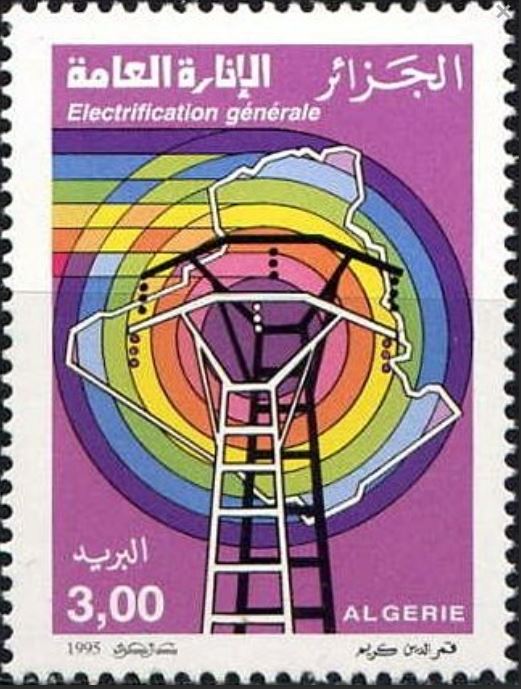
General electrification
At independence, the electrification of the country revealed a disparity between the coast and the rest of the country, on the one hand, and between urban and rural areas, on the other. This reflected the geographic distribution of populations under colonization. Only Europeans living on the coast and in urban areas benefited from most of the achievements.
Public authorities very early perceived the importance of rural electrification as a vector of economic, social and cultural progress. From 1965, electrification actions were initiated through special programs which enabled 150,000 connections for 6,800 km of networks between 1965 and 1975.
In 1976, a new approach followed ad hoc programming. This involves the adoption of the National Electrification Plan (PNE) fully financed by the State. To implement the PNE, the National Electricity and Gas Company (Sonelgaz) created the Electrification Directorate which became the independent public company Kahrif in 1983. The massive electrification of villages and towns has induced spectacular socio-cultural transformations in the country and in the rural world in particular.
A source of progress, electricity has become essential. The constantly growing demand and the continuous evolution of consumption show the place that electrical energy occupies in a country which aspires to development and well-being. Furthermore, the National Electrification Plan was the driving force behind the electrical equipment manufacturing industry and enabled hundreds of executives and technicians to acquire remarkable experience.
The PNE's ambition to achieve total electrification of the country (more than 96%) seems within reach. The program selected for the 1995-1998 period aims to connect 178,000 households spread across 3,473 centers and 318 agricultural areas. This will lead to the construction of more than 26,000 km of networks, 6 micro diesel power plants and 19 micro solar power plants. The financial requirements for its implementation are estimated at more than 16 billion dinars.
Public authorities very early perceived the importance of rural electrification as a vector of economic, social and cultural progress. From 1965, electrification actions were initiated through special programs which enabled 150,000 connections for 6,800 km of networks between 1965 and 1975.
In 1976, a new approach followed ad hoc programming. This involves the adoption of the National Electrification Plan (PNE) fully financed by the State. To implement the PNE, the National Electricity and Gas Company (Sonelgaz) created the Electrification Directorate which became the independent public company Kahrif in 1983. The massive electrification of villages and towns has induced spectacular socio-cultural transformations in the country and in the rural world in particular.
A source of progress, electricity has become essential. The constantly growing demand and the continuous evolution of consumption show the place that electrical energy occupies in a country which aspires to development and well-being. Furthermore, the National Electrification Plan was the driving force behind the electrical equipment manufacturing industry and enabled hundreds of executives and technicians to acquire remarkable experience.
The PNE's ambition to achieve total electrification of the country (more than 96%) seems within reach. The program selected for the 1995-1998 period aims to connect 178,000 households spread across 3,473 centers and 318 agricultural areas. This will lead to the construction of more than 26,000 km of networks, 6 micro diesel power plants and 19 micro solar power plants. The financial requirements for its implementation are estimated at more than 16 billion dinars.