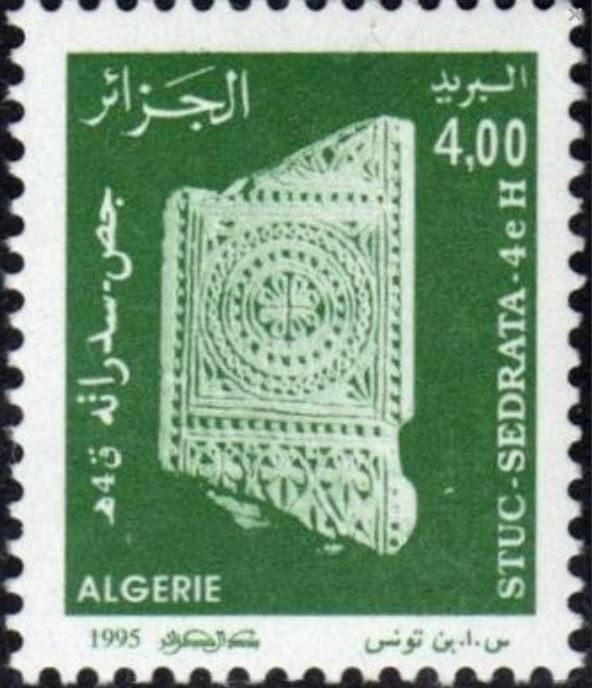
Stucco Sedrana from the 4th Century AH
Algerian sculptures on plaster Sedrata
4th century AH
In the year 908, the Ibadites, founders of the kingdom of Tihert (Tiaret), were chased from their capital after its destruction by the Fatimids. They emigrated to the Sahara and founded a new capital near Ouargla, known as Issedraten, where they tried to revive two centuries of the splendor of their first capital. Among the travelers and archaeologists who explored the site of Sedrata and undertook excavations there, we can cite Victor Largeau, author of a work entitled Le Pays du Rirha, Ouargla et Ghadamès.
The remains exhumed from the sands of Sedrata are those of a building believed to be a mosque and private residences richly decorated with sand-colored sculpted plaster.
These buildings reveal details of Mesopotamian architecture and abundant ornamentation, the geometric decoration of which includes the square, the circle and the rosette. What characterizes this decor and contributes to giving it a primitive appearance is the absence of any molding and almost any modeling.
The form seems silhouetted in the still fresh plaster with a wooden or iron tool. The edges of the relief are perpendicular to the background or inclined towards the viewer. Some motifs are beveled, as are the geometric ornaments carved on wood in the Aurès or Kabylia since Roman times.
Source: National Museum of Antiquities, Algiers
4th century AH
In the year 908, the Ibadites, founders of the kingdom of Tihert (Tiaret), were chased from their capital after its destruction by the Fatimids. They emigrated to the Sahara and founded a new capital near Ouargla, known as Issedraten, where they tried to revive two centuries of the splendor of their first capital. Among the travelers and archaeologists who explored the site of Sedrata and undertook excavations there, we can cite Victor Largeau, author of a work entitled Le Pays du Rirha, Ouargla et Ghadamès.
The remains exhumed from the sands of Sedrata are those of a building believed to be a mosque and private residences richly decorated with sand-colored sculpted plaster.
These buildings reveal details of Mesopotamian architecture and abundant ornamentation, the geometric decoration of which includes the square, the circle and the rosette. What characterizes this decor and contributes to giving it a primitive appearance is the absence of any molding and almost any modeling.
The form seems silhouetted in the still fresh plaster with a wooden or iron tool. The edges of the relief are perpendicular to the background or inclined towards the viewer. Some motifs are beveled, as are the geometric ornaments carved on wood in the Aurès or Kabylia since Roman times.
Source: National Museum of Antiquities, Algiers