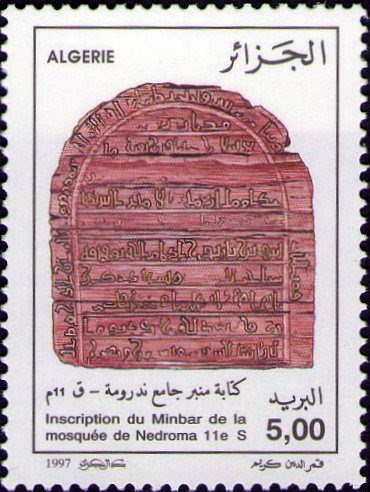
Minbar of the Nedroma Mosque (11th century)
In Algeria, the trade of woodwork, woodwork and wood decoration constituted an activity which reflects and conveys in a very beautiful way two values: aesthetic demands and practical utility. Several types of wood were used in this trade such as thuja, cedar, pine, holm oak, cork oak, pear and olive. The main centers of timber were in Algiers, Kabylia, Tlemcen and certain regions in the south. The main wooden works produced are: painted or carved chests, coffee tables, painted cradles, Koran doors, doors and preaching pulpits, etc.
Inscription of the Minbar of the Nédroma Mosque (wilaya of Tlemcen)
This inscription is engraved on a cedar plaque. It has the shape of a raised hanger 1 m high and 0.72 m wide, and is currently deposited in the National Museum of Antiquities in Algiers.
It includes two parts, the first takes place around the perimeter and has only one line, the second adorns the central part of the plaque and has eleven lines, several of which are erased. The Kufic characters that make up the inscription are of rarely equaled beauty and purity.
Historians have not been able to agree on the name of the prince mentioned on the pulpit of this mosque. It can be admitted that this chair was made during the reign of Youcef Ben Tachfin, and even specified that it was made before 479 hegira/1086, the date of the victory of Zallaga won by the Almoravids over the Christians of Spain. Because after this event, leader Lamtuna became Amir El Muslimin (prince of Muslims) and would not have tolerated being given the simple title of Al Sayyid.
Inscription of the Minbar of the Nédroma Mosque (wilaya of Tlemcen)
This inscription is engraved on a cedar plaque. It has the shape of a raised hanger 1 m high and 0.72 m wide, and is currently deposited in the National Museum of Antiquities in Algiers.
It includes two parts, the first takes place around the perimeter and has only one line, the second adorns the central part of the plaque and has eleven lines, several of which are erased. The Kufic characters that make up the inscription are of rarely equaled beauty and purity.
Historians have not been able to agree on the name of the prince mentioned on the pulpit of this mosque. It can be admitted that this chair was made during the reign of Youcef Ben Tachfin, and even specified that it was made before 479 hegira/1086, the date of the victory of Zallaga won by the Almoravids over the Christians of Spain. Because after this event, leader Lamtuna became Amir El Muslimin (prince of Muslims) and would not have tolerated being given the simple title of Al Sayyid.