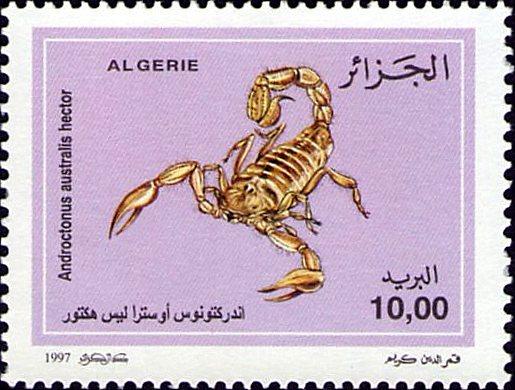
Scorpion Androctonus australis hector
Morphological characterization of the most widespread scorpions. Scorpions are distinguished from other arachnids by the venom gland which is located at the last segment of the tail, venom vesicle or Telson. The scorpion Androctonus australis hector or man-killer is distinguished from the scorpion Buthus occitanus tunetanus by its size which can reach 10 cm in adults, while that of the Buthus does not exceed 7.5 cm.
The body is divided into cephalothorax and abdomen. While the brown color of the Buthus occitanus tunetanus scorpion is uniform throughout the body, that of the Androctonus australis hector scorpion is straw yellow. This color is not uniform throughout the body since the color of the latter's thick tail is dark, particularly at the level of rings 4 and 5 and the Telson which is itself black. The jaw legs and sting of Androctonus australis hector are swollen, while those of Buthus occitanus tunetanus are rather thin. The sting of the Androctonus australis hector is curved.
Habitat. Scorpions are generally nocturnal animals living in colonies in warm countries. Some of them live in humid places, while others prefer desert regions. However, they are capable of adapting to different biotopes.
In Algeria, they are distributed in the south of the Hauts Plateaux. Scorpion envenomation poses an enormous public health problem. The dangers for humans are real and the fight against scorpion stings is an important public health problem in many regions of Algeria, the most affected of which are those in the South and the Hauts Plateaux (El Bayadh, M'sila, Laghouat, Béchar, Naâma, Ouargla, Biskra, Tamanrasset, Illizi, etc.). The Ministry of Health and Population has recorded around 30,000 bites on average, including around a hundred deaths per year. The number of people bitten is greater during the hot season and the people most affected are those in the age group between 13 and 30 years old. In Algeria, surveillance and the fight against this scourge are ensured by the competent services of the Ministry of Health and Population.
The treatment of stung people is carried out in particular by administering antiscorpion serum, produced by the Pasteur Institute in Algiers. In collaboration with the other Pasteur Institutes of the Maghreb and that of Paris, studies are currently being carried out at the Venom Research and Development Laboratory at the Pasteur Institute of Algiers. These studies are undertaken with a view to improving the quality of antiscorpion serum and for better serotherapy for people who have been bitten. It must be emphasized that the fight against scorpion envenomation also involves improving the housing, hygiene and living conditions of the populations concerned.
The body is divided into cephalothorax and abdomen. While the brown color of the Buthus occitanus tunetanus scorpion is uniform throughout the body, that of the Androctonus australis hector scorpion is straw yellow. This color is not uniform throughout the body since the color of the latter's thick tail is dark, particularly at the level of rings 4 and 5 and the Telson which is itself black. The jaw legs and sting of Androctonus australis hector are swollen, while those of Buthus occitanus tunetanus are rather thin. The sting of the Androctonus australis hector is curved.
Habitat. Scorpions are generally nocturnal animals living in colonies in warm countries. Some of them live in humid places, while others prefer desert regions. However, they are capable of adapting to different biotopes.
In Algeria, they are distributed in the south of the Hauts Plateaux. Scorpion envenomation poses an enormous public health problem. The dangers for humans are real and the fight against scorpion stings is an important public health problem in many regions of Algeria, the most affected of which are those in the South and the Hauts Plateaux (El Bayadh, M'sila, Laghouat, Béchar, Naâma, Ouargla, Biskra, Tamanrasset, Illizi, etc.). The Ministry of Health and Population has recorded around 30,000 bites on average, including around a hundred deaths per year. The number of people bitten is greater during the hot season and the people most affected are those in the age group between 13 and 30 years old. In Algeria, surveillance and the fight against this scourge are ensured by the competent services of the Ministry of Health and Population.
The treatment of stung people is carried out in particular by administering antiscorpion serum, produced by the Pasteur Institute in Algiers. In collaboration with the other Pasteur Institutes of the Maghreb and that of Paris, studies are currently being carried out at the Venom Research and Development Laboratory at the Pasteur Institute of Algiers. These studies are undertaken with a view to improving the quality of antiscorpion serum and for better serotherapy for people who have been bitten. It must be emphasized that the fight against scorpion envenomation also involves improving the housing, hygiene and living conditions of the populations concerned.