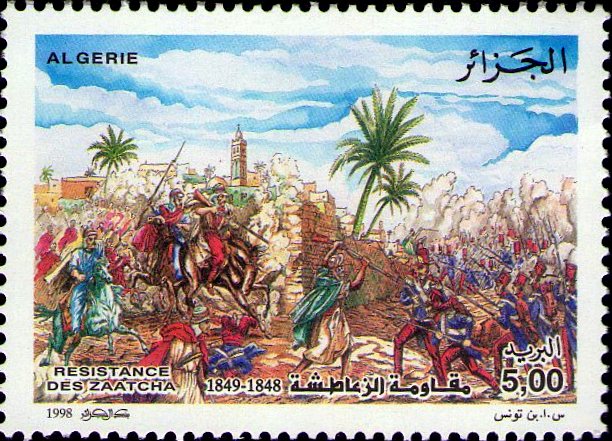
150th Anniversary of the Zaatcha Resistance 1848-1849
The Zaatcha resistance is among the most important revolts that marked the fight against the colonial presence and had a great influence on the Algerian people. Triggered in 1848 in the Zibans-Dahraoui region, precisely in the Zaâtcha oasis, 35 km southwest of Biskra, this resistance was led by Bouziane, sheikh of the Zibans, in the company of resistance fighters, such as Mohamed Ben Abderrahmane, who fought alongside Emir Abdelkader.
Exasperated by the foreign presence on their soil, suffering economically in this region of the Oases, due to the dispossession of their lands, the degradation of crops, as well as a drastic levy of taxes, the inhabitants of the oasis organized themselves thanks to the companions of Emir Abdelkader to face the French occupation. Attempting to isolate the resistance by limiting it in the Zaâtcha region to avoid its extension to other regions, the occupying army brought together 4,493 men from eastern Algeria by concentrating them in Meïda and Lichana, 500 meters from the zaouïa of Cheikh Bouziane.
The area is surrounded for two months. Cannons were installed and bombardments ordered to breach the walls surrounding the zaouïa and facilitate the attack. Violent fighting took place and numerous losses were counted in the ranks of the occupying forces. All the inhabitants take up arms and regroup in the oasis, attacking day and night. Many volunteers joined the ranks of the resistance of the inhabitants of the oasis against the French army, which reinforced its troops from 11,000 to 19,267 soldiers and brought in significant war equipment.
After heroic resistance, Cheikh Bouziane and his son Hadj Moussa fell as martyrs and their heads were exhibited at the gates of Biskra. The number of losses in the Algerian camp is very heavy: 800 dead. All of the Oases were reoccupied in 1849. As soon as the oasis was taken over, the French army committed the worst abuses by executing 1,500 people and cutting down 10,000 palm trees. All those involved in this repression were promoted to high positions by the colonial authorities of the time.
Exasperated by the foreign presence on their soil, suffering economically in this region of the Oases, due to the dispossession of their lands, the degradation of crops, as well as a drastic levy of taxes, the inhabitants of the oasis organized themselves thanks to the companions of Emir Abdelkader to face the French occupation. Attempting to isolate the resistance by limiting it in the Zaâtcha region to avoid its extension to other regions, the occupying army brought together 4,493 men from eastern Algeria by concentrating them in Meïda and Lichana, 500 meters from the zaouïa of Cheikh Bouziane.
The area is surrounded for two months. Cannons were installed and bombardments ordered to breach the walls surrounding the zaouïa and facilitate the attack. Violent fighting took place and numerous losses were counted in the ranks of the occupying forces. All the inhabitants take up arms and regroup in the oasis, attacking day and night. Many volunteers joined the ranks of the resistance of the inhabitants of the oasis against the French army, which reinforced its troops from 11,000 to 19,267 soldiers and brought in significant war equipment.
After heroic resistance, Cheikh Bouziane and his son Hadj Moussa fell as martyrs and their heads were exhibited at the gates of Biskra. The number of losses in the Algerian camp is very heavy: 800 dead. All of the Oases were reoccupied in 1849. As soon as the oasis was taken over, the French army committed the worst abuses by executing 1,500 people and cutting down 10,000 palm trees. All those involved in this repression were promoted to high positions by the colonial authorities of the time.