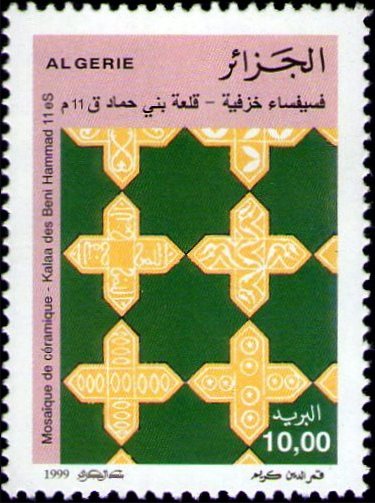
Ceramic Mosaic - Kalaa of Beni Hammad 11th Century
The marquetry of the Kalaâ of Béni Hammad – 5th century AH – is made up of the juxtaposition of regular shapes, cut out of raw earth, then baked and covered with enamel which is fixed by a second firing. These inlays are placed on the ground to serve as paving or are applied against the walls.
Constructed in the shape of a cross with cut sides, arranged around an eight-pointed star, these ceramic inlays are in solid tones: green, white or purple. This earthenware mosaic has painted decorations with metallic reflections with an epigraphy of monumental characters called Kufics. In Western Islamic ceramics, there are two usual inscriptions, wishes or fragments of pious formulas: “el moulk” (royalty) and “el youmn” (happiness).
The second of these formulas, clearly expressed on the covering plates with metallic reflections, seems to have become a sort of cliché of the earthenware makers of the Kalaâ des Béni Hammad. This technique, which continues today under the name of zellige, remains associated with the decoration of places of worship and sumptuous residences.
Constructed in the shape of a cross with cut sides, arranged around an eight-pointed star, these ceramic inlays are in solid tones: green, white or purple. This earthenware mosaic has painted decorations with metallic reflections with an epigraphy of monumental characters called Kufics. In Western Islamic ceramics, there are two usual inscriptions, wishes or fragments of pious formulas: “el moulk” (royalty) and “el youmn” (happiness).
The second of these formulas, clearly expressed on the covering plates with metallic reflections, seems to have become a sort of cliché of the earthenware makers of the Kalaâ des Béni Hammad. This technique, which continues today under the name of zellige, remains associated with the decoration of places of worship and sumptuous residences.