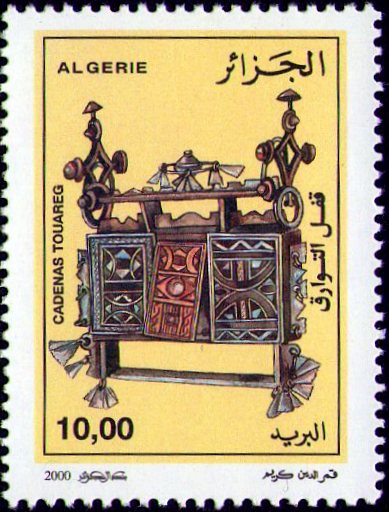
Touareg padlock
These are padlocks that are found among all the nomads of the Touareg group and particularly in the Adrar des Iforas, in the northern Saharan zone in Algeria (Tassili, Ahaggar, Touat and Saoura). If we consider their geographic expansion in West Africa, we see that they are present throughout the Tuareg area of influence.
These padlocks are little masterpieces of elementary mechanics, to ensure the closure of leather bags (clothing or shopping bags) and also that of store doors.
These padlocks are made with very few tools and perfect knowledge of file, hammer and solder, dimensions can vary from 3 cm X 2 cm to 16 cm X 8 cm approximately with thicknesses from 0.5 cm to 2.5 cm; those of the keys range from 3 to 20 cm in length.
The body of the padlock is adorned externally with chiseled plates of tin, yellow and red copper (sometimes silver). The side edges have indented ridges. The key, made of iron, can be thin and sober, decorated on one side with chiseled copper.
The padlock consists of three parts:
- The body of the padlock: parallelepiped of riveted and brazed iron plates, provided at its lower part with an entrance and a longitudinal slot allowing the key to slide. At its upper part, a hollow metal rod forms a stirrup with the second part.
- The mobile part: includes the closing system: two leaf springs mounted as a harpoon on a metal rod, above this assembly, a rigid rod is introduced into the hollow part of the stirrup, blocking after locking the springs.
- The key: which allows you to open the padlock is a narrow and solid metal plate. Despite the numerous decorations with which it is often adorned, it only has one functional part: the window part which will, by sliding into the body of the padlock, tighten the two leaf springs. This key is also an element of adornment and counterweight in women's clothing.
These padlocks are little masterpieces of elementary mechanics, to ensure the closure of leather bags (clothing or shopping bags) and also that of store doors.
These padlocks are made with very few tools and perfect knowledge of file, hammer and solder, dimensions can vary from 3 cm X 2 cm to 16 cm X 8 cm approximately with thicknesses from 0.5 cm to 2.5 cm; those of the keys range from 3 to 20 cm in length.
The body of the padlock is adorned externally with chiseled plates of tin, yellow and red copper (sometimes silver). The side edges have indented ridges. The key, made of iron, can be thin and sober, decorated on one side with chiseled copper.
The padlock consists of three parts:
- The body of the padlock: parallelepiped of riveted and brazed iron plates, provided at its lower part with an entrance and a longitudinal slot allowing the key to slide. At its upper part, a hollow metal rod forms a stirrup with the second part.
- The mobile part: includes the closing system: two leaf springs mounted as a harpoon on a metal rod, above this assembly, a rigid rod is introduced into the hollow part of the stirrup, blocking after locking the springs.
- The key: which allows you to open the padlock is a narrow and solid metal plate. Despite the numerous decorations with which it is often adorned, it only has one functional part: the window part which will, by sliding into the body of the padlock, tighten the two leaf springs. This key is also an element of adornment and counterweight in women's clothing.