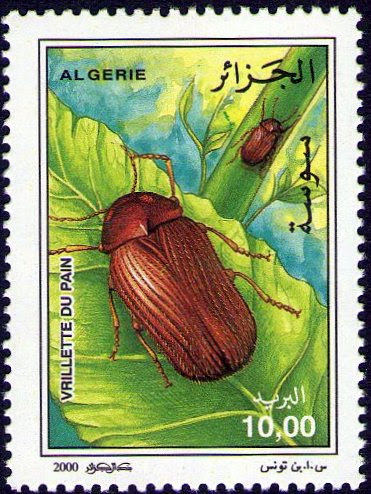
The bread twist
Reddish brown in color, oval in shape and covered in fine hairs, adult insects are 2 to 4 mm long. The head is hidden under the prothorax which has a regular arch and the elytra have fine dotted bands. The last three segments of the antennae are particularly long. The larva, which resembles a white worm, reaches a length of 5 mm. The female lays a maximum of 20 to 100 eggs, which she deposits separately or in small piles on suitable nutrient materials.
The tiny young larvae slip through even the finest cracks and enter, for example, food packaging. Once they arrive in the substrate, they then surround themselves with a cocoon of food particles, a cocoon in which they complete their transformation into nymphs.
The complete evolution requires approximately 200 days at 17°C and only 70 days at a temperature of 26°C.
The breadworm is spreading all over the world. It is a significant pest of homes and warehouses, particularly when infested merchandise is stored untouched for long enough. The larvae are typical eaters.
They are found in all possible plant materials such as biscuits and other floury and cereal products, herbal products, spices, seeds and cakes. In the case of a heavy infestation, the solid materials are perforated with small round holes. The insect itself does not feed at all.
The tiny young larvae slip through even the finest cracks and enter, for example, food packaging. Once they arrive in the substrate, they then surround themselves with a cocoon of food particles, a cocoon in which they complete their transformation into nymphs.
The complete evolution requires approximately 200 days at 17°C and only 70 days at a temperature of 26°C.
The breadworm is spreading all over the world. It is a significant pest of homes and warehouses, particularly when infested merchandise is stored untouched for long enough. The larvae are typical eaters.
They are found in all possible plant materials such as biscuits and other floury and cereal products, herbal products, spices, seeds and cakes. In the case of a heavy infestation, the solid materials are perforated with small round holes. The insect itself does not feed at all.