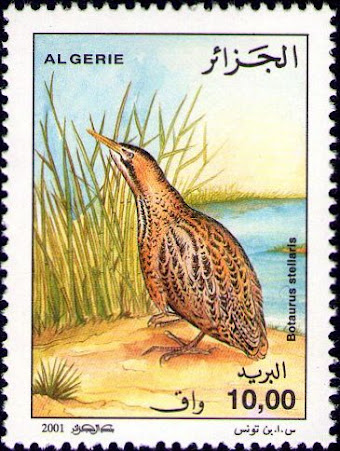
Botaurus stellaris - Starry Bittern
The great bittern (Botaurus stellaris) is a wading bird from the Ardeidae family (herons, egrets).
Present in Europe and Asia, it lives in humid areas with very dense malaria vegetation. In winter, it migrates further south, where the water does not freeze.
Etymology
The Latin term for bittern, Botaurus, refers to the bull. The other part of its scientific name, stellaris in Latin, means star in reference to its plumage.
Appearance
It is a large, massive heron, warm brown streaked with darker brown, very similar to the American bittern (Botaurus lentiginosa). Its length varies from 69 to 81 cm and its wingspan from 100 to 130 cm.
It is very mimetic and difficult to observe in its habitat, the reed beds. It can generally be seen in flight over short distances. The silhouette is then typical, resembling a mixture of a great owl and a heron. Its presence is especially confirmed by listening to its very powerful song (audible up to 5 km) and resembling a 'fog horn'. The song is heard mainly at night.
Housing
The Great Bittern inhabits densely vegetated environments with shallow open water surfaces with little variation in level. It is found in particular in marshes, swamps, large ponds, lake banks and large reed beds.
Food
It feeds on fish, amphibians and invertebrates, but sometimes it can hunt birds or small mammals.
Behavior
The Great Bittern hides in the common reeds of wetland reed beds. Usually solitary, it moves furtively in search of amphibians and fish to feed on. If it feels that it has been seen, it becomes motionless and points its bill upwards so as to blend in with the surrounding reeds. It is most active at dawn and dusk.
Distribution
The Great Bittern is a typically European species distributed from Spain to Russia. The European population is estimated between 20,000 and 43,000 singing males, including 10,000 to 30,000 for Russia.
In France, the current population is estimated between 300 and 400 singing males spread over three areas: the Mediterranean coast, Loire-Atlantique and the departments of the north and north-east of France.
Preservation
Its population is in sharp decline throughout Europe due to the disappearance of wetlands. Many of the traditional nesting areas have been drained or the density of malaria vegetation has greatly decreased. In some places, hunting is another danger to the species. Throughout Europe there are between 1000 and 2000 pairs.
At European level, the species is considered 'Vulnerable'. The European population would have suffered a decline of 20% between 1970 and 1990.
Source: Wikipedia, the free encyclopedia.
Present in Europe and Asia, it lives in humid areas with very dense malaria vegetation. In winter, it migrates further south, where the water does not freeze.
Etymology
The Latin term for bittern, Botaurus, refers to the bull. The other part of its scientific name, stellaris in Latin, means star in reference to its plumage.
Appearance
It is a large, massive heron, warm brown streaked with darker brown, very similar to the American bittern (Botaurus lentiginosa). Its length varies from 69 to 81 cm and its wingspan from 100 to 130 cm.
It is very mimetic and difficult to observe in its habitat, the reed beds. It can generally be seen in flight over short distances. The silhouette is then typical, resembling a mixture of a great owl and a heron. Its presence is especially confirmed by listening to its very powerful song (audible up to 5 km) and resembling a 'fog horn'. The song is heard mainly at night.
Housing
The Great Bittern inhabits densely vegetated environments with shallow open water surfaces with little variation in level. It is found in particular in marshes, swamps, large ponds, lake banks and large reed beds.
Food
It feeds on fish, amphibians and invertebrates, but sometimes it can hunt birds or small mammals.
Behavior
The Great Bittern hides in the common reeds of wetland reed beds. Usually solitary, it moves furtively in search of amphibians and fish to feed on. If it feels that it has been seen, it becomes motionless and points its bill upwards so as to blend in with the surrounding reeds. It is most active at dawn and dusk.
Distribution
The Great Bittern is a typically European species distributed from Spain to Russia. The European population is estimated between 20,000 and 43,000 singing males, including 10,000 to 30,000 for Russia.
In France, the current population is estimated between 300 and 400 singing males spread over three areas: the Mediterranean coast, Loire-Atlantique and the departments of the north and north-east of France.
Preservation
Its population is in sharp decline throughout Europe due to the disappearance of wetlands. Many of the traditional nesting areas have been drained or the density of malaria vegetation has greatly decreased. In some places, hunting is another danger to the species. Throughout Europe there are between 1000 and 2000 pairs.
At European level, the species is considered 'Vulnerable'. The European population would have suffered a decline of 20% between 1970 and 1990.
Source: Wikipedia, the free encyclopedia.