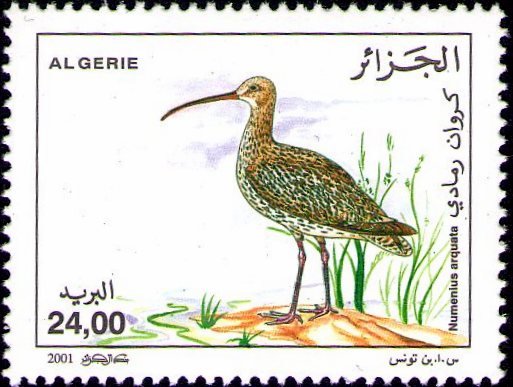
Numenius arquata - Eurasian Curlew
The Eurasian Curlew, Numenius arquata, is a shorebird belonging to the large family Scolopacidae. It is that of the curlews which inhabits the most extensive space, since it reproduces throughout temperate Europe and Asia. They have even been seen in Nova Scotia. In Europe it is often simply called curlew.
It is a migratory species throughout most of its range, hibernating in Africa, southern Europe and southern Asia. It is present all year round in the milder climate of Ireland, Great Britain and neighboring European coasts. It is extremely gregarious outside the breeding season.
It is the largest wader of its kind, with a length of 50-57 centimeters and a wingspan of 1 m. It is mainly grayish brown, with a white hindquarters and a very long, curved bill (longer in adult females). He is generally fearful. The familiar call from which this bird takes its name is a resounding curlew.
The only species that resembles it over most of its habitat is the Whimbrel. This one is smaller, with a shorter beak showing a sort of bend rather than a regular curve.
This species feeds by digging through soft mud for small invertebrates, but occasionally catches small crabs and earthworms from the surface.
The nest is laid bare in the taiga, meadow or similar habitat. From 3 to 6 eggs are laid and incubated for about a month until hatching.
The Eurasian Curlew is one of the species to which the Agreement on the Conservation of African-Eurasian Migratory Waterbirds applies.
Source: Wikipedia, the free encyclopedia.
It is a migratory species throughout most of its range, hibernating in Africa, southern Europe and southern Asia. It is present all year round in the milder climate of Ireland, Great Britain and neighboring European coasts. It is extremely gregarious outside the breeding season.
It is the largest wader of its kind, with a length of 50-57 centimeters and a wingspan of 1 m. It is mainly grayish brown, with a white hindquarters and a very long, curved bill (longer in adult females). He is generally fearful. The familiar call from which this bird takes its name is a resounding curlew.
The only species that resembles it over most of its habitat is the Whimbrel. This one is smaller, with a shorter beak showing a sort of bend rather than a regular curve.
This species feeds by digging through soft mud for small invertebrates, but occasionally catches small crabs and earthworms from the surface.
The nest is laid bare in the taiga, meadow or similar habitat. From 3 to 6 eggs are laid and incubated for about a month until hatching.
The Eurasian Curlew is one of the species to which the Agreement on the Conservation of African-Eurasian Migratory Waterbirds applies.
Source: Wikipedia, the free encyclopedia.