1st International Conference on Saint-Augustin
As part of the celebration, in 2001, of the International Year of Dialogue between Civilizations, decided by the UN, Algeria will honor the figure of the universal genius and man of dialogue who was the Algerian philosopher Augustin. Organized at the initiative of Mr. Abdelaziz Bouteflika, President of the Algerian Republic, and in partnership with the Swiss Confederation, the first international conference, which will be held from April 1 to 7, 2001, will have the themes "Augustine and Africanness" to highlight his attachment to his homeland, Numidia (today's Algeria), and "Augustine and universality" to highlight the universal dimension of his thought. Aurélien Augustin was born in Tagaste (Souk Ahras) in 354 AD, two centuries before the revelation of the Koran. He died in Hippo (Annaba) in 430.
Philosopher, writer of genius, theologian, polemicist, mystic, Saint Augustine is one of the great thinkers who left a strong mark on the history of human thought. During his lifetime, he enjoyed great fame throughout all the countries of the Mediterranean Basin. His work is immense and some of his works are circumstantial and polemically inspired (for example against the Manichaeans, the Donatists and the Pelagians). In addition to his two works, the Confessions and The City of God, we must cite the 224 letters written between 386 and 429, the 700 sermons and the dogmatic and moral theological treatises (The Orders), the educational and exegetical works. His writings are among the most translated and are the subject of research and teaching in scientific and religious institutions on five continents.
More than 500 books and articles on the subject of Saint Augustine and his imposing work are published each year in the main languages of the world. The conference is placed under the high patronage of the President of the Algerian Republic. Its organization was entrusted to the High Islamic Council (Algiers), the University of Friborg (Switzerland) and the Institute of Augustinian Studies (Rome). An international preparatory committee is responsible for ensuring the organization of this conference which will take place in two sessions, the first in Algiers from April 1 to 4, 2001 and the second in Annaba from April 5 to 7. It will include conferences and a major exhibition relating to the life and work of Saint Augustine. Documentary publications and CD-ROMs will be produced on this occasion. Guided tours will take place on various known sites, in Tagaste (Souk Ahras), in Madaure (M'daourouch) where he was a schoolboy, in Calama (Guelma) where his most faithful friend, disciple and biographer Possidius lived and finally in Hippo (Annaba) where he was a bishop and lived for 39 years (from 391 to 430).
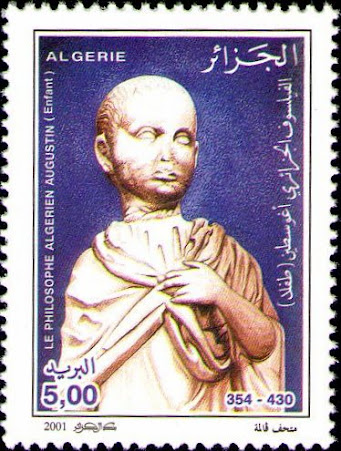
The two postage stamps will represent one the effigy of Saint Augustine as a child based on a statue found in the Madaure theater and kept at the Guelma museum and the other a mosaic from the 4th century AD dealing with concord and peace, available at the Tipaza museum.
Saint Augustine's Basilica
The Saint-Augustin basilica dominates the archaeological site of Hippo, currently Annaba. It was started in 1881 on a grandiose idea from Bishop Dupuch, a great admirer of Saint Augustine, who arrived in Annaba in 1839. The project provided for a church well integrated into the history and natural and cultural environment of Hippo and its surroundings. From the top of its promontory, its majestic port overlooks the vast plain spread out at its feet and the admirable bay of Annaba limited by the line of the two capes which frame it. In a style of Arab-Byzantine inspiration, today's basilica was built with marble taken from Algerian soil. A 300-year-old Berber chest serves as an altar, evoking the origins of Saint Augustine.
A universal reach
The University of Friborg is a stakeholder in the first conference organized in Algeria on the philosopher Augustine, at the initiative of the President of the Republic. Friborg has long maintained very close ties with Saint Augustine. Dom Morin, publisher of sermons discovered at the beginning of the 20th century, Abbé Dutoit, chronicler of Augustine in La Liberté, and Othmar Perler, author of the Travels of Saint Augustin, are all Friborg figures who have left their mark on Augustinian research. The torch was taken up by Otto Wermelinger of the Patristics Seminar at the University of Fribourg. Organizer of a conference on Saint Augustine and Manichaeism in 1998, he also participated in the Algiers conference.
Philosopher, writer of genius, theologian, polemicist, mystic, Saint Augustine is one of the great thinkers who left a strong mark on the history of human thought. During his lifetime, he enjoyed great fame throughout all the countries of the Mediterranean Basin. His work is immense and some of his works are circumstantial and polemically inspired (for example against the Manichaeans, the Donatists and the Pelagians). In addition to his two works, the Confessions and The City of God, we must cite the 224 letters written between 386 and 429, the 700 sermons and the dogmatic and moral theological treatises (The Orders), the educational and exegetical works. His writings are among the most translated and are the subject of research and teaching in scientific and religious institutions on five continents.
More than 500 books and articles on the subject of Saint Augustine and his imposing work are published each year in the main languages of the world. The conference is placed under the high patronage of the President of the Algerian Republic. Its organization was entrusted to the High Islamic Council (Algiers), the University of Friborg (Switzerland) and the Institute of Augustinian Studies (Rome). An international preparatory committee is responsible for ensuring the organization of this conference which will take place in two sessions, the first in Algiers from April 1 to 4, 2001 and the second in Annaba from April 5 to 7. It will include conferences and a major exhibition relating to the life and work of Saint Augustine. Documentary publications and CD-ROMs will be produced on this occasion. Guided tours will take place on various known sites, in Tagaste (Souk Ahras), in Madaure (M'daourouch) where he was a schoolboy, in Calama (Guelma) where his most faithful friend, disciple and biographer Possidius lived and finally in Hippo (Annaba) where he was a bishop and lived for 39 years (from 391 to 430).
The two postage stamps will represent one the effigy of Saint Augustine as a child based on a statue found in the Madaure theater and kept at the Guelma museum and the other a mosaic from the 4th century AD dealing with concord and peace, available at the Tipaza museum.
Saint Augustine's Basilica
The Saint-Augustin basilica dominates the archaeological site of Hippo, currently Annaba. It was started in 1881 on a grandiose idea from Bishop Dupuch, a great admirer of Saint Augustine, who arrived in Annaba in 1839. The project provided for a church well integrated into the history and natural and cultural environment of Hippo and its surroundings. From the top of its promontory, its majestic port overlooks the vast plain spread out at its feet and the admirable bay of Annaba limited by the line of the two capes which frame it. In a style of Arab-Byzantine inspiration, today's basilica was built with marble taken from Algerian soil. A 300-year-old Berber chest serves as an altar, evoking the origins of Saint Augustine.
A universal reach
The University of Friborg is a stakeholder in the first conference organized in Algeria on the philosopher Augustine, at the initiative of the President of the Republic. Friborg has long maintained very close ties with Saint Augustine. Dom Morin, publisher of sermons discovered at the beginning of the 20th century, Abbé Dutoit, chronicler of Augustine in La Liberté, and Othmar Perler, author of the Travels of Saint Augustin, are all Friborg figures who have left their mark on Augustinian research. The torch was taken up by Otto Wermelinger of the Patristics Seminar at the University of Fribourg. Organizer of a conference on Saint Augustine and Manichaeism in 1998, he also participated in the Algiers conference.