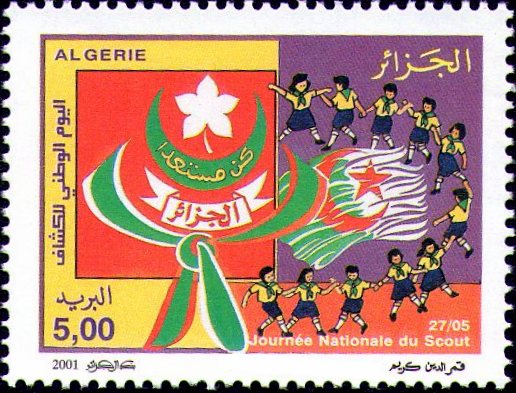
National Scout Day
The first scout troops were created in a few large cities in the country between 1934 and 1939. Subsequently, the Federation of Algerian Muslim Scouts (SMA), chaired by Mohamed Bouras, achieved the unity of all groups and spread scouting throughout Algeria. The SMAs set themselves the task of training responsible leaders and educating young people in three physical, moral and civic aspects. In their educational action, SMA leaders applied the universal principles of world scouting, while adapting them to the cultural, linguistic, economic and political realities of Algeria. The various SMA congresses, in particular that of Sidi Fredj in 1947, affirmed the nationalist orientation of the movement, the attachment of the scouts to the homeland and to Islamic moral values.
The SMAs helped raise national awareness among young people and safeguard cultural and moral heritage. They paid a heavy price during the period of organization of Algerian nationalism and during the War of National Liberation. At the independence congress in October 1962, the general orientation of the movement and its objectives were clarified according to the imperatives of the reconstruction of the country. The SMA actively participated in all national construction and reconstruction campaigns, multiplying training camps and youth camps. They took part in jamborees and major international activities.
During the recovery congress held in 1989, the SMA stood out from any partisan affiliation and took up the real scout spirit as it was conceived by founder Mohamed Bouras. Algerian Muslim Scouts are recognized by world scouting and are part of the Arab Scouting Bureau.
Cubism
In Scouts, children aged 7 to 12 are called Cub Scouts. A specific education method – whose playful framework is based on The Jungle Book by Rudyard Kipling – is adapted to them. Cubism is a pedagogy essentially focused on play. Its principle boils down to the fact that play constitutes the natural activity of children. It is therefore a matter of supervising them and organizing educational activities in the form of games in order to arouse their interest. The cub learns to fend for himself within a geographically defined framework – the playing area – and according to the instructions given to him or the rules of the game.
The SMAs helped raise national awareness among young people and safeguard cultural and moral heritage. They paid a heavy price during the period of organization of Algerian nationalism and during the War of National Liberation. At the independence congress in October 1962, the general orientation of the movement and its objectives were clarified according to the imperatives of the reconstruction of the country. The SMA actively participated in all national construction and reconstruction campaigns, multiplying training camps and youth camps. They took part in jamborees and major international activities.
During the recovery congress held in 1989, the SMA stood out from any partisan affiliation and took up the real scout spirit as it was conceived by founder Mohamed Bouras. Algerian Muslim Scouts are recognized by world scouting and are part of the Arab Scouting Bureau.
Cubism
In Scouts, children aged 7 to 12 are called Cub Scouts. A specific education method – whose playful framework is based on The Jungle Book by Rudyard Kipling – is adapted to them. Cubism is a pedagogy essentially focused on play. Its principle boils down to the fact that play constitutes the natural activity of children. It is therefore a matter of supervising them and organizing educational activities in the form of games in order to arouse their interest. The cub learns to fend for himself within a geographically defined framework – the playing area – and according to the instructions given to him or the rules of the game.