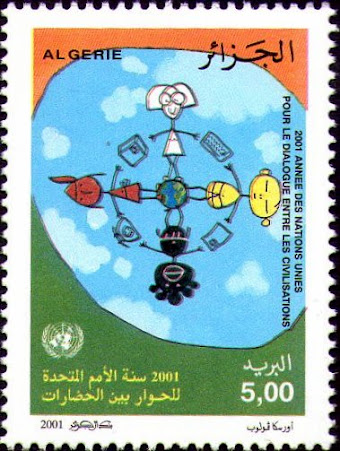
United Nations Year of Dialogue among Civilizations
In accordance with the principles set out in the Charter of the United Nations, which notably advocates a collective effort to strengthen friendly relations among Nations, remove threats to peace and promote international cooperation in the economic, social, cultural and humanitarian fields and encourage and develop human rights, the year 2001 was proclaimed "United Nations year of dialogue among civilizations".
The achievements of different civilizations constitute the heritage of humanity. They bear witness to cultural pluralism and the various forms of creativity of human beings. The concept of nation in its most modern sense does not imply a break with this civilizational heritage; on the contrary, it must be accepted and integrated into the heritage of humanity.
It should also be noted that the last few millennia have seen the main civilizations take the mold of the great religions which constituted their cradle. Their constant interactions led to an alternation between dialogue and confrontation. The regulation, at the planetary level, of these variations will make it possible to favor dialogue on conflict and promote peace.
Today, countries poor in resources but rich in culture could fear that some of the ethical and social values to which they are attached and which had suffered from confiscation could be truncated again by a one-dimensional model coming from materially prosperous countries.
It will therefore be a question of establishing a fruitful and balanced dialogue between civilizations at very different levels of development, including and particularly in the reductive context of globalization.
The merit of the dialogue between civilizations is found in the quest of man in his universality under the innumerable cultural expressions that he has given himself across space and time. This is a real antidote to racism, intolerance and discrimination.
The achievements of different civilizations constitute the heritage of humanity. They bear witness to cultural pluralism and the various forms of creativity of human beings. The concept of nation in its most modern sense does not imply a break with this civilizational heritage; on the contrary, it must be accepted and integrated into the heritage of humanity.
It should also be noted that the last few millennia have seen the main civilizations take the mold of the great religions which constituted their cradle. Their constant interactions led to an alternation between dialogue and confrontation. The regulation, at the planetary level, of these variations will make it possible to favor dialogue on conflict and promote peace.
Today, countries poor in resources but rich in culture could fear that some of the ethical and social values to which they are attached and which had suffered from confiscation could be truncated again by a one-dimensional model coming from materially prosperous countries.
It will therefore be a question of establishing a fruitful and balanced dialogue between civilizations at very different levels of development, including and particularly in the reductive context of globalization.
The merit of the dialogue between civilizations is found in the quest of man in his universality under the innumerable cultural expressions that he has given himself across space and time. This is a real antidote to racism, intolerance and discrimination.