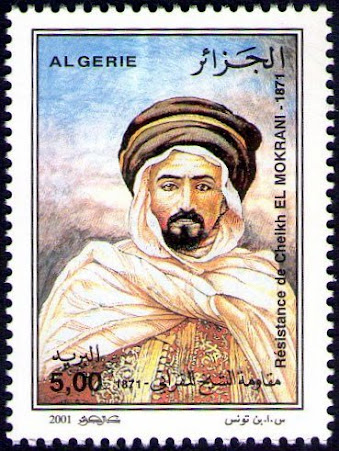
130th anniversary of the resistance of Sheikh EL MOKRANI
El Mokrani son of El Khalifa El Hadj Ahmed El Mokrani was part of Ahmed Bey's forces. After his father's death in 1853, he succeeded him in the position of Bach Agha.
Since his appointment as Bach Agha, Sheikh El Mokrani was the subject of a lot of pressure and suffered enormous problems created by the colonial administration.
Following the proclamation of the decree of October 24, 1870 abolishing the military regime and its replacement by a civilian regime, Sheikh El Mokrani presented his resignation from the post of Bach Agha, handed over his monthly salary to the French authorities and returned his rank of Bach Agha to the Ministry of War. Represented by the “Burnous” of the function This fact was to constitute the main reason for the organization of the revolt of Cheikh el Mokrani.
The other main causes which led to the Cheikh El Mokrani revolt are:
- The famine which devastated the Algerian population between 1867-1868 and which caused many victims without the French authorities providing aid to the victims.
- The actions of the church, under the leadership of Lavigerie, to Christianize Algerian orphans exploiting the famine which affected the population. The suppression of Arab offices chaired by French officers.
- The problem of the debt contracted in 1869 by Cheikh El Mokrani to help famine victims and Algerian farmers
- The proclamation of the Crémieux decree in 1871 granting French nationality en masse to the Jews of Algeria.
On March 16, 1871, Cheikh El Mokrani began his offensive towards Bordj Bou Arreridj with an army made up of 7,000 cavalrymen to extend to other regions of the national territory. Sheikh El Mokrani continued his revolt until May 5, 1871. He was mortally wounded in Oued Souflat in the region of Ain Bessam wilaya of Bouira and was secretly transported to the Qalaà of Beni Abbes and buried in the cemetery of his ancestors. The revolt continued after his death until the end of January 1873, by his brother Boumezrag El Mokrani, deported in 1874 to New Caledonia.
Since his appointment as Bach Agha, Sheikh El Mokrani was the subject of a lot of pressure and suffered enormous problems created by the colonial administration.
Following the proclamation of the decree of October 24, 1870 abolishing the military regime and its replacement by a civilian regime, Sheikh El Mokrani presented his resignation from the post of Bach Agha, handed over his monthly salary to the French authorities and returned his rank of Bach Agha to the Ministry of War. Represented by the “Burnous” of the function This fact was to constitute the main reason for the organization of the revolt of Cheikh el Mokrani.
The other main causes which led to the Cheikh El Mokrani revolt are:
- The famine which devastated the Algerian population between 1867-1868 and which caused many victims without the French authorities providing aid to the victims.
- The actions of the church, under the leadership of Lavigerie, to Christianize Algerian orphans exploiting the famine which affected the population. The suppression of Arab offices chaired by French officers.
- The problem of the debt contracted in 1869 by Cheikh El Mokrani to help famine victims and Algerian farmers
- The proclamation of the Crémieux decree in 1871 granting French nationality en masse to the Jews of Algeria.
On March 16, 1871, Cheikh El Mokrani began his offensive towards Bordj Bou Arreridj with an army made up of 7,000 cavalrymen to extend to other regions of the national territory. Sheikh El Mokrani continued his revolt until May 5, 1871. He was mortally wounded in Oued Souflat in the region of Ain Bessam wilaya of Bouira and was secretly transported to the Qalaà of Beni Abbes and buried in the cemetery of his ancestors. The revolt continued after his death until the end of January 1873, by his brother Boumezrag El Mokrani, deported in 1874 to New Caledonia.