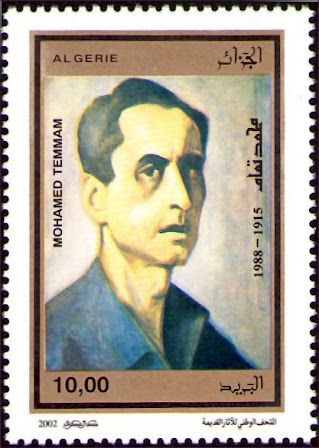
The Artist (Mohamed Temmam 1915-1988)
Born on February 23, 1915 in the Casbah of Algiers, Mohamed Temmam is considered one of the most notable visual artists in Algeria, as well as one of the very few to have mastered both traditional modes of expression, notably miniatures and illumination, as well as easel painting which he practiced as a portraitist or landscape painter. He was also a good violinist attached to the Andalusian classical school which he had known very young with the great Algerian masters and the prestigious groups of El Moutribiya and El Mossiliya. However, it was as a miniaturist and illuminator that he established his notoriety, which is partly explained by the fact that he was one of the precursors of the genre alongside the Racim brothers, his childhood neighbors. From the age of thirteen, while continuing his schooling, he entered the Arts School on rue des Consuls where he was introduced to traditional arts (known as indigenous) and learned ceramics from the master Emile Soupireau. Noted for his talent, in 1936 he obtained a scholarship to the Ecole Supérieure des Arts Decoratifs in Paris. He spent nearly thirty years in this city and in Europe, where discovery, youthful enthusiasm, artistic expression and trials combined. He was eager for knowledge and new techniques, rubbed shoulders with the then abundant artistic trends and frequented all artistic circles, especially musicians and visual artists. We find it at the Sèvres factory where it adorns official service pieces. In 1937, taking advantage of a visit to Algiers, he organized his first exhibition. His long stay in Paris and his frequent attendance of North African orchestras where he sometimes played allowed him to meet the companion of his life, the singer Bahia Farah. These good years were followed by a dark period. The Second World War broke out and he was taken prisoner from 1939 to 1943. Upon his release, as if to make up for lost time, he appeared through numerous exhibitions. In 1944, he participated in an exhibition of Algerian illuminators and miniaturists. In 1946, thanks to Mohamed Racim, he participated in exhibitions in Scandinavia. From that year and until 1957, his works appeared regularly in the various editions of the Salon des surindépendants and the Salon des painters maghrébins. These were also the years of the National Liberation War and through his works, he strived to illustrate the Algerian personality and contributed more directly to the struggle among activists of the national cause. In 1963, having regained his independence, he returned definitively to Algeria where he became curator of the National Museum of Antiquities in Algiers, a position he held until his death. In 1964, he organized the first exhibition on Muslim arts at the Salle Pierre-Bordes, today Ibn Khaldoun. A founding member of the National Union of Plastic Arts, he devoted time to teaching at the National School of Fine Arts in Algiers. The death of Bahia Farah in 1984, but also his personality of humility and discretion led him to a sort of withdrawal. He continues to produce miniatures, illuminations, calligraphies, painting canvases, models of banknotes, etc. He responds to various invitations and requests and sometimes performs pieces of music in a restricted circle. But overcome by a silent weariness and worn out by age, he ends up being carried away by illness. He died on July 15, 1988 in Algiers. He is buried in the El Kettar cemetery near his family. Mohamed Temmam, a talented artist, contributed, between 1968 and 1986, to the creation of numerous postage stamps magnifying the historical and cultural heritage of Algeria.