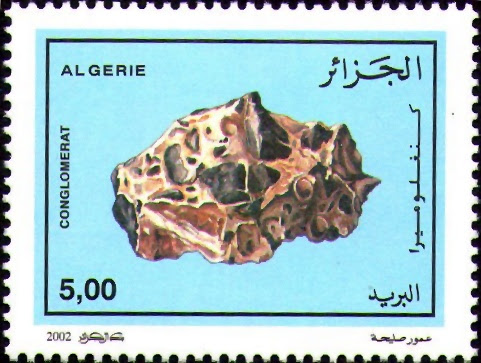
Conglomerate
Miocene conglomerate containing Jurassic limestone-Moustiers-Sainte-Marie. In petrography, a conglomerate is a detrital rock (resulting from the mechanical degradation of other rocks) composed of pieces linked together by natural cement. To be considered discernible, the pieces must measure more than 2 mm (below this size, we would be dealing with a sandstone and no longer a conglomerate). Conglomerates are most often sedimentary in nature, but they can also be volcanic.
Among the conglomerates, we find:
- the breccias, composed of angular blocks;
- puddingues, made up of rounded pebbles;
- and tillites which contain both angular pebbles and rounded pebbles.
Many conglomerates were formed when the sea invaded a originally continental surface (transgression), in a low area. Sparnacien pudding from Nemours south of Fontainebleau
We call ossiferous conglomerate a conglomerate rich in bones of reptiles, birds and mammals: example of the conglomerates of the lower tertiary discovered at Meudon in 1836
Among the conglomerates, we find:
- the breccias, composed of angular blocks;
- puddingues, made up of rounded pebbles;
- and tillites which contain both angular pebbles and rounded pebbles.
Many conglomerates were formed when the sea invaded a originally continental surface (transgression), in a low area. Sparnacien pudding from Nemours south of Fontainebleau
We call ossiferous conglomerate a conglomerate rich in bones of reptiles, birds and mammals: example of the conglomerates of the lower tertiary discovered at Meudon in 1836