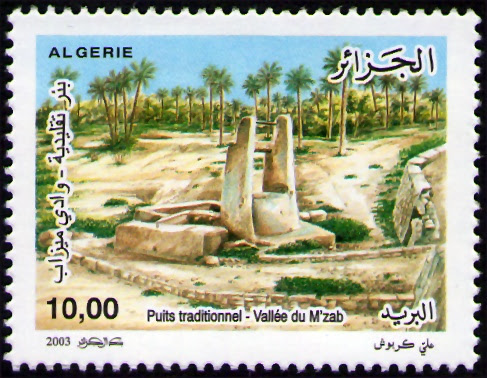
Traditional well in the M'Zab valley (Ghardaia)
2003: International Year of Fresh Water
While the supply of fresh water is an ordinary and quite easy act in the West, many places around the world consider water to be a rare commodity and often extremely difficult to access. Indeed, more than a billion people still do not have regular drinking water, and around twice that number suffer from a lack of adequate sanitation services. The result is that more than 250 million people, mostly in developing countries, are affected by water-borne diseases, and more than 2 million children and adults die each year.
The international community, aware of the priority represented by access to fresh water and basic sanitation services, has emphasized the need to take urgent measures to ensure equitable and sustainable supplies for all humanity. For this, the United Nations proclaimed 2003 as the International Year of Fresh Water.
Among the main objectives set by the UN, to be achieved by 2015, is reducing by half the proportion of people who cannot afford drinking water and do not have access to sanitation services. The guarantee of better management of the world's fresh water resources, in order to avoid waste and inefficient consumption, as well as the adoption of policies to be followed by governments and the various parties concerned.
In order to contribute to raising awareness of the importance of water and the protection of its quality, Algérie Poste wanted to participate in international action through the issue of three postage stamps, the theme of which emphasizes 'water and traditional know-how'. This series will illustrate ancestral water management practices (water table recharge, surface water collection and flood water distribution), particularly in Ghardaïa, Relizane and Timimoun.
Well coping in the M'Zab valley (Ghardaia)
The well, called “khettara”, or “tirest”, is dug to great depths. The coping, built in local stone and plaster, is topped by two uprights which support a pulley. In the palm grove, drawing is done using animal traction along a towing area. In the oasis, it is done using vertical traction by man.
While the supply of fresh water is an ordinary and quite easy act in the West, many places around the world consider water to be a rare commodity and often extremely difficult to access. Indeed, more than a billion people still do not have regular drinking water, and around twice that number suffer from a lack of adequate sanitation services. The result is that more than 250 million people, mostly in developing countries, are affected by water-borne diseases, and more than 2 million children and adults die each year.
The international community, aware of the priority represented by access to fresh water and basic sanitation services, has emphasized the need to take urgent measures to ensure equitable and sustainable supplies for all humanity. For this, the United Nations proclaimed 2003 as the International Year of Fresh Water.
Among the main objectives set by the UN, to be achieved by 2015, is reducing by half the proportion of people who cannot afford drinking water and do not have access to sanitation services. The guarantee of better management of the world's fresh water resources, in order to avoid waste and inefficient consumption, as well as the adoption of policies to be followed by governments and the various parties concerned.
In order to contribute to raising awareness of the importance of water and the protection of its quality, Algérie Poste wanted to participate in international action through the issue of three postage stamps, the theme of which emphasizes 'water and traditional know-how'. This series will illustrate ancestral water management practices (water table recharge, surface water collection and flood water distribution), particularly in Ghardaïa, Relizane and Timimoun.
Well coping in the M'Zab valley (Ghardaia)
The well, called “khettara”, or “tirest”, is dug to great depths. The coping, built in local stone and plaster, is topped by two uprights which support a pulley. In the palm grove, drawing is done using animal traction along a towing area. In the oasis, it is done using vertical traction by man.