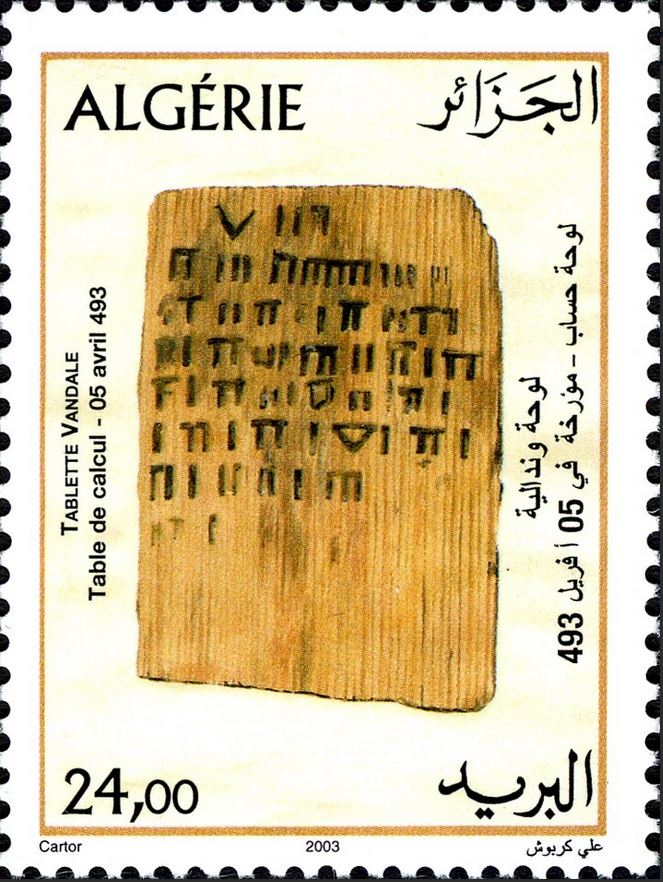
Vandal Tablets Calculation tablet (established April 5, 493)
“Tablet”, “Tabella” in Latin, generally refers to wooden boards intended for writing used in antiquity. Made of a rectangle of common wood, they were hollowed out with a second, smaller rectangle for writing, so as to protect and handle them. It was from the year 61, under the emperor Nero, that a law regulated the use of the tablets, which had to include a closure cord passed three times and sealed.
The cedar wood tablets from the Vandal era, called "Albertini tablets", named after a French archaeologist, Eugène Albertini, the first to have studied them, dating back to the year 493 and 494. They reveal a significant number of private legal acts: purchase, sale and contracts... They inform us about the nature of the transactions, by their officialization and bear the name of the reigning king, the nature of the contract, the established finding, the warranty, seller's subscription, names of witnesses and signature of the scribe.
Discovered in 1928 in Moscott (Tebessa) by farmers, they are divided into two distinct groups. The first is mainly composed of acts of sale of goods, slaves and an act bearing the dowry of a young girl. The second consists mainly of fragments of tablets, many of which are incomplete. These tablets are kept at the National Museum of Antiquities in Algiers. Two of these acts were repeated through an issue of postage stamps dedicated to this universal heritage.
Note that these tablets were recently the subject of a unique exhibition in Sweden, where they were restored for the occasion. For this country, they remain a precious witness to the memory of a people often unfairly judged.
Calculation tablet (established April 5, 493)
Calculation tablet from the Vandal era, which was part of a triptych (three parts) bill of sale.
The cedar wood tablets from the Vandal era, called "Albertini tablets", named after a French archaeologist, Eugène Albertini, the first to have studied them, dating back to the year 493 and 494. They reveal a significant number of private legal acts: purchase, sale and contracts... They inform us about the nature of the transactions, by their officialization and bear the name of the reigning king, the nature of the contract, the established finding, the warranty, seller's subscription, names of witnesses and signature of the scribe.
Discovered in 1928 in Moscott (Tebessa) by farmers, they are divided into two distinct groups. The first is mainly composed of acts of sale of goods, slaves and an act bearing the dowry of a young girl. The second consists mainly of fragments of tablets, many of which are incomplete. These tablets are kept at the National Museum of Antiquities in Algiers. Two of these acts were repeated through an issue of postage stamps dedicated to this universal heritage.
Note that these tablets were recently the subject of a unique exhibition in Sweden, where they were restored for the occasion. For this country, they remain a precious witness to the memory of a people often unfairly judged.
Calculation tablet (established April 5, 493)
Calculation tablet from the Vandal era, which was part of a triptych (three parts) bill of sale.