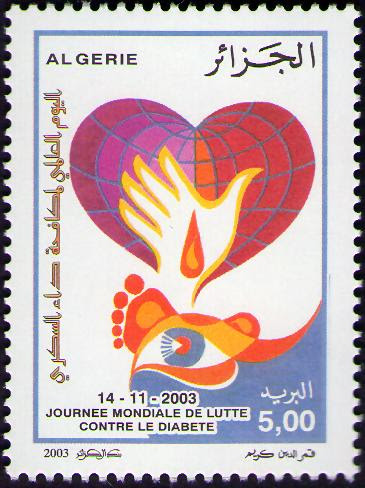
World Diabetes Day
Since the first man, we have been omnivores genetically programmed to eat fat-free meat and fiber plants. Physical exercise has always allowed us to acquire our food (hunting, fishing and gathering.) We have thus been able to subsist and even live quite well and evolve.
Less than ten thousand years ago, the Neolithic revolution introduced cultivation and breeding. Food choice and sedentary lifestyle induce previously unknown conditions. The industrial revolution of the last century aggravated this drift.
The overload diseases of insulin resistance syndrome They strike many of us, they are even more common in certain ethnic groups. They are the diseases of the 20th century and even more so of the 21st century. Knowledge of the lifestyle of our ancestors helps us predict and treat these diseases.
National associative movements, such as the “Lions Clubs International District 415 Algeria”, whose fiftieth anniversary will be celebrated on November 14, 2003, work for national solidarity and the fight against diabetes and blindness. The program initiated by this association is to organize scientific, educational and sporting events (diabetic marathons).
In Algeria, there are more than 1 million diabetics, 10% of whom are type 1 (insulin-dependent diabetes), the rest are type 2 (non-insulin-dependent diabetes).
Diabetes is a chronic, common disease. It currently affects more than 150 million people worldwide. It is a state of chronic hyperglycemia, that is to say an excessive concentration of glucose in the blood which results from numerous environmental and genetic factors often acting in concert.
The full participation of the patient is essential in the management of the disease, particularly for monitoring and treatment. The seriousness of diabetes is due to its long-silent complications. They are often diagnosed too late at an advanced stage where they are irreversible.
However, these complications are not inevitable; they can be avoided by early diagnosis, personalized treatment and planned medical follow-up.
A profound and lasting change in behavior and eating habits is necessary.
The complications it causes are ophthalmological, renal, cardiovascular and neurological, hence the slogan “good foot – good eye”.
Less than ten thousand years ago, the Neolithic revolution introduced cultivation and breeding. Food choice and sedentary lifestyle induce previously unknown conditions. The industrial revolution of the last century aggravated this drift.
The overload diseases of insulin resistance syndrome They strike many of us, they are even more common in certain ethnic groups. They are the diseases of the 20th century and even more so of the 21st century. Knowledge of the lifestyle of our ancestors helps us predict and treat these diseases.
National associative movements, such as the “Lions Clubs International District 415 Algeria”, whose fiftieth anniversary will be celebrated on November 14, 2003, work for national solidarity and the fight against diabetes and blindness. The program initiated by this association is to organize scientific, educational and sporting events (diabetic marathons).
In Algeria, there are more than 1 million diabetics, 10% of whom are type 1 (insulin-dependent diabetes), the rest are type 2 (non-insulin-dependent diabetes).
Diabetes is a chronic, common disease. It currently affects more than 150 million people worldwide. It is a state of chronic hyperglycemia, that is to say an excessive concentration of glucose in the blood which results from numerous environmental and genetic factors often acting in concert.
The full participation of the patient is essential in the management of the disease, particularly for monitoring and treatment. The seriousness of diabetes is due to its long-silent complications. They are often diagnosed too late at an advanced stage where they are irreversible.
However, these complications are not inevitable; they can be avoided by early diagnosis, personalized treatment and planned medical follow-up.
A profound and lasting change in behavior and eating habits is necessary.
The complications it causes are ophthalmological, renal, cardiovascular and neurological, hence the slogan “good foot – good eye”.