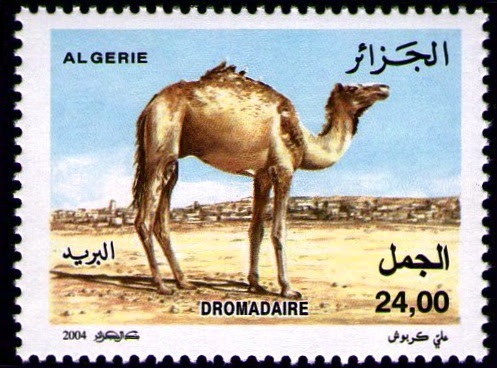
The camel
The dromedary is a species of camelid, of the genus camelus, order of ruminants, like the camel. It is distinguished by a slender appearance, up to 3 meters long and 2.40 m high at the withers, a light coat with short hair and has only one hump unlike its Asian counterpart.
A typical figure of the Middle East and Africa, the dromedary has perfectly adapted to its particularly hostile environment. Its exceptional endurance in hot desert environments has favored its domestication by man, who makes it a beast of burden while ensuring its survival. Indeed, the animal which travels without drinking several hundred kilometers in temperatures sometimes approaching 70°C, has for a long time constituted the only means of transport of men and goods across the immense deserts, contributing to the multiple exchanges between peoples. An ideal companion for nomads and caravanners, it has fully deserved its nickname 'dessert vessel'.
Algeria, a country in North Africa, only has the species 'camélus dromadirius' (dromedary), the trade of which would have been carried out by the nomadic tribes who crisscrossed Asia and Africa. This is present in several Wilayas covering the Sahara and the steppe zones. Currently, the herd is estimated at around 150,000 head, mainly divided into the following breeds:
'Chaambi',
'Ouled Sidi El Cheikh',
'Sahrawi',
'Ait Khebbach',
'Reguibi',
'The Ajjer'.
The breeding of the species is experiencing a significant boost, particularly through the strengthening of measures taken in recent years, such as the financial aid granted to breeders as well as the drilling of wells along the routes. Its vocation of meat, 180 kg per carcass on average, as well as that of milk, approximately 6 liters per female daily.
A typical figure of the Middle East and Africa, the dromedary has perfectly adapted to its particularly hostile environment. Its exceptional endurance in hot desert environments has favored its domestication by man, who makes it a beast of burden while ensuring its survival. Indeed, the animal which travels without drinking several hundred kilometers in temperatures sometimes approaching 70°C, has for a long time constituted the only means of transport of men and goods across the immense deserts, contributing to the multiple exchanges between peoples. An ideal companion for nomads and caravanners, it has fully deserved its nickname 'dessert vessel'.
Algeria, a country in North Africa, only has the species 'camélus dromadirius' (dromedary), the trade of which would have been carried out by the nomadic tribes who crisscrossed Asia and Africa. This is present in several Wilayas covering the Sahara and the steppe zones. Currently, the herd is estimated at around 150,000 head, mainly divided into the following breeds:
'Chaambi',
'Ouled Sidi El Cheikh',
'Sahrawi',
'Ait Khebbach',
'Reguibi',
'The Ajjer'.
The breeding of the species is experiencing a significant boost, particularly through the strengthening of measures taken in recent years, such as the financial aid granted to breeders as well as the drilling of wells along the routes. Its vocation of meat, 180 kg per carcass on average, as well as that of milk, approximately 6 liters per female daily.