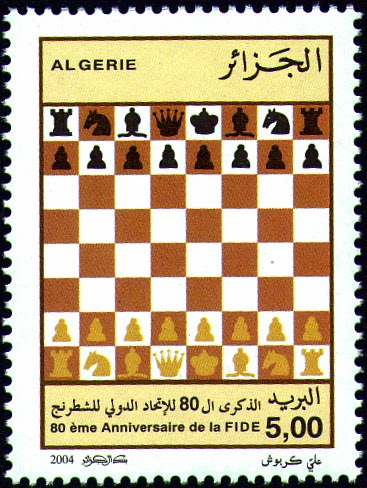
80th Anniversary of FIDE
Chess games appeared in India in the 6th century BC. Known as Chaturanga or exercise game, they quickly spread throughout Asia thanks to trade routes. Arabs have embraced chess with unparalleled enthusiasm. They studied it, analyzed its mechanisms in depth, wrote numerous treatises and developed the algebraic notation system. The game arrived in Europe between the 700s and 900s through the conquest of Spain by Islam.
During the Middle Ages, it was in Spain and Italy that the game was most played. We played according to the rules laid down by the Arabs, described in the treaties adopted and translated by Alphonse the Wise. The centuries that followed would see a remarkable improvement in the game.
At the end of the 19th century, the first chess competitions began to be organized. In 1914, an important tournament was held in Saint Petersburg during which Tsar Nicholas II established the title of 'International Grandmaster', granted to the five finalists Emmanuel Lacker, Alexander Alekhine, José Capablanca, Siegbert Tarrasch and Frank Marshall.
In 1924, the International Chess Federation (FIDE), a global regulatory body for the game, was founded in Paris. It will wait until 1989 to be declared by the International Olympic Committee (IOC) the supreme institution for the organization of championships on a global scale. Ten years later, it was recognized as an International Sports Federation.
Currently, FIDE, which brings together 161 member countries, is one of the most dynamic sports organizations with millions of practitioners.
The Algerian Chess Federation (FADE) was created on June 15, 1973 and approved on June 26, 1975. It is affiliated with the various International Chess authorities. FADE currently has 38 leagues, 20 of which are active, more than 100 clubs and thousands of players. It is responsible for the promotion, development and organization of the practice of chess games in Algeria.
Chess games, as they are played today, retain a medieval character. It is a game of warriors and courtiers, as the names of the actions of the pieces attest. It was the game of kings and today it is the king of games.
During the Middle Ages, it was in Spain and Italy that the game was most played. We played according to the rules laid down by the Arabs, described in the treaties adopted and translated by Alphonse the Wise. The centuries that followed would see a remarkable improvement in the game.
At the end of the 19th century, the first chess competitions began to be organized. In 1914, an important tournament was held in Saint Petersburg during which Tsar Nicholas II established the title of 'International Grandmaster', granted to the five finalists Emmanuel Lacker, Alexander Alekhine, José Capablanca, Siegbert Tarrasch and Frank Marshall.
In 1924, the International Chess Federation (FIDE), a global regulatory body for the game, was founded in Paris. It will wait until 1989 to be declared by the International Olympic Committee (IOC) the supreme institution for the organization of championships on a global scale. Ten years later, it was recognized as an International Sports Federation.
Currently, FIDE, which brings together 161 member countries, is one of the most dynamic sports organizations with millions of practitioners.
The Algerian Chess Federation (FADE) was created on June 15, 1973 and approved on June 26, 1975. It is affiliated with the various International Chess authorities. FADE currently has 38 leagues, 20 of which are active, more than 100 clubs and thousands of players. It is responsible for the promotion, development and organization of the practice of chess games in Algeria.
Chess games, as they are played today, retain a medieval character. It is a game of warriors and courtiers, as the names of the actions of the pieces attest. It was the game of kings and today it is the king of games.