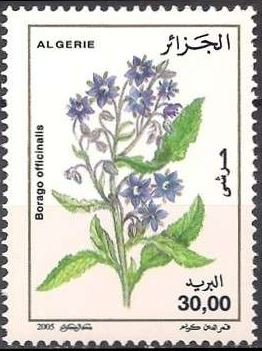
Borage (Borago officinalis)
A family of Borraginaceae, borage is native to the Mediterranean and West Asia. It takes its name from the Arabic 'abu rache' (father of sweat) because of its sudorific properties. It is a herbaceous, branchy, bristly annual plant, the size of which varies from 20 to 60 cm. The leaves are petiolate, ovoid or oblong, the upper ones sessile. The flowers are blue, rarely white or pink, with long pedicellates, in solitary or twin clusters. They are leafy at the base, united in a loose panicle. The carpels are oblong, fleshy on both sides, striated lengthwise, tubercular at the top.
In Algeria, this plant, present in fields and crops, is common throughout Tell.
Borage oil
In the past, borage was mainly used for its medicinal properties (sudorific, diuretic, emollient). It is part of the 4 flower herbal tea which is a great classic, perfectly effective against colds, bronchitis and flu if you drink it all day long. In pharmacy, Borraginaceae occupied a reduced place in ancient times before disappearing almost completely. But, towards the end of the 1960s, the American laboratory in Peoria carried out systematic research on the seed oils of Borraginaceae and borage clearly stood out from the crowd. It is only recently that borage has been cultivated for its seed which produces an oil rich in gamma linolenic acid (GLA). The seeds contain 30 to 35% fat including 16 to 23% GLA.
In Algeria, this plant, present in fields and crops, is common throughout Tell.
Borage oil
In the past, borage was mainly used for its medicinal properties (sudorific, diuretic, emollient). It is part of the 4 flower herbal tea which is a great classic, perfectly effective against colds, bronchitis and flu if you drink it all day long. In pharmacy, Borraginaceae occupied a reduced place in ancient times before disappearing almost completely. But, towards the end of the 1960s, the American laboratory in Peoria carried out systematic research on the seed oils of Borraginaceae and borage clearly stood out from the crowd. It is only recently that borage has been cultivated for its seed which produces an oil rich in gamma linolenic acid (GLA). The seeds contain 30 to 35% fat including 16 to 23% GLA.