Koranic Schools The Madrasa of Algiers
The name madrasa has several vocations, it means college, academy and university at the same time. Made famous by the Tlemcenian colleges, it was preserved by the French authorities who established three medersas in Algeria; in Constantine, Tlemcen and Médéa (later transferred to Algiers) in 1851.
A true temple of knowledge, this place reserved for the elite of the Muslim population, provided courses in Arabic grammar and literature, law and jurisprudence, theology, French language, arithmetic and geometry. At the end of three years of study, candidates admitted to the exams received a diploma entitled 'Brevet d'Etudes Musulmanes'.
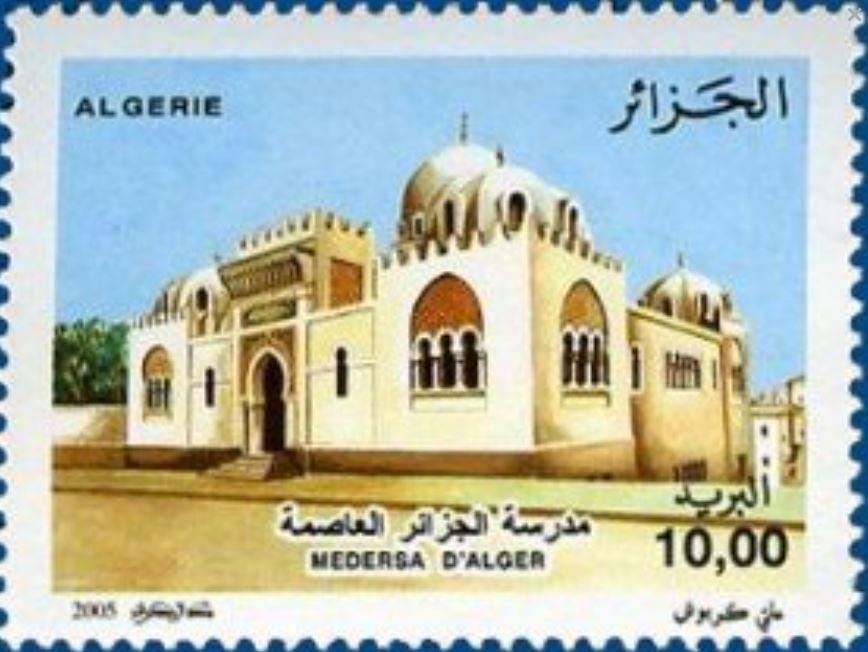
The Algiers Madrasa
The El-Thaâlibiya Madrasa, a higher education establishment, is one of the Moorish-style public buildings erected in Algeria at the request of Governor General C.Jonnart.
This construction is the work of the architect Petit and was inaugurated in 1904.
By the order and shape of their decoration, the large dome and the rooms present a most harmonious architectural setting.
Four domes flank the central dome, a vestibule and a porch open between the two domes of the main facade.
All of the walls are lined, halfway up, with paneled earthenware tiles.
For around fifty years, the building has no longer served its purpose as a higher establishment for Medersians.
The Zaouïas
In the 15th century, numerous zaouïas (brotherhoods), such as those of Tidjaniya, Rahmaniya, Derqaouiya, Kadiriya, Djazouliya, Senoussiya, etc. emerge in the Maghreb. The zaouïa is a real institution around which life in the region is organized. It is a place of prayer, of dikr (ritual of litanies particular to each zaouïa and each religious order). Religious knowledge is provided there and, first of all, the learning of the Koran. The zaouïas radiate throughout the country. They are chaired by a moqaddem, bearer of his message to his disciples, or khouan. The zaouïas, which have long constituted a real net enclosing in its meshes the entire social body of the country, live thanks to donations from zakat and other sadaqate.
A true temple of knowledge, this place reserved for the elite of the Muslim population, provided courses in Arabic grammar and literature, law and jurisprudence, theology, French language, arithmetic and geometry. At the end of three years of study, candidates admitted to the exams received a diploma entitled 'Brevet d'Etudes Musulmanes'.
The Algiers Madrasa
The El-Thaâlibiya Madrasa, a higher education establishment, is one of the Moorish-style public buildings erected in Algeria at the request of Governor General C.Jonnart.
This construction is the work of the architect Petit and was inaugurated in 1904.
By the order and shape of their decoration, the large dome and the rooms present a most harmonious architectural setting.
Four domes flank the central dome, a vestibule and a porch open between the two domes of the main facade.
All of the walls are lined, halfway up, with paneled earthenware tiles.
For around fifty years, the building has no longer served its purpose as a higher establishment for Medersians.
The Zaouïas
In the 15th century, numerous zaouïas (brotherhoods), such as those of Tidjaniya, Rahmaniya, Derqaouiya, Kadiriya, Djazouliya, Senoussiya, etc. emerge in the Maghreb. The zaouïa is a real institution around which life in the region is organized. It is a place of prayer, of dikr (ritual of litanies particular to each zaouïa and each religious order). Religious knowledge is provided there and, first of all, the learning of the Koran. The zaouïas radiate throughout the country. They are chaired by a moqaddem, bearer of his message to his disciples, or khouan. The zaouïas, which have long constituted a real net enclosing in its meshes the entire social body of the country, live thanks to donations from zakat and other sadaqate.