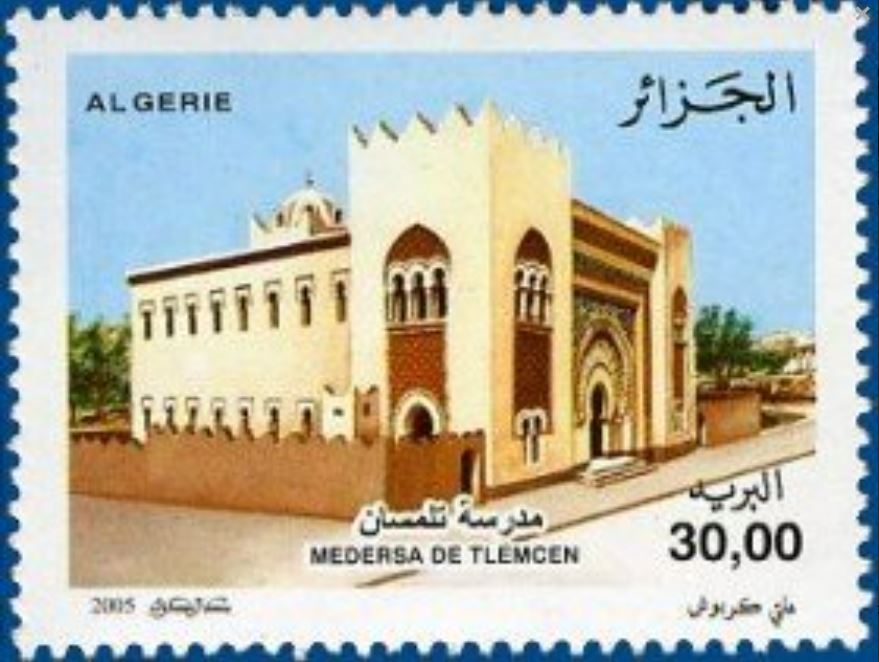
Koranic Schools The Madrasa of Tlemcen
In 1905, France inaugurated the famous 'medersa' in Tlemcen which was in fact the cradle of 'orientalism' dedicated to the Maghreb lands. The greatest French scientists have been stationed in Tlemcen; William and Georges MARCAIS, Alfred BELL or Maurice GAUDEFROY-DEMOMBYNES.
Built next to the mausoleum of Sidi Maâmar Ben Ali, it is built in the arbor-Moorish style, presenting a magnificent facade inspired by the mihrab of the great mosque, with arabesques in earthenware mosaic with several towers. A beautiful courtyard paved with marble and numerous classrooms. A large basin 200m long, 100m wide and 3m deep, dug by Abou Tachfine.
The Tlemcen madrasa gave birth to several national figures, such as Cheikh Zerdoumi, Si Kadour Naimi, Chaouch and Moulay Slimane. She also paid a heavy price during the revolution, with martyrs such as Dib, Allali and many others.
The Zaouïas
In the 15th century, numerous zaouïas (brotherhoods), such as those of Tidjaniya, Rahmaniya, Derqaouiya, Kadiriya, Djazouliya, Senoussiya, etc. emerge in the Maghreb. The zaouïa is a real institution around which life in the region is organized. It is a place of prayer, of dikr (ritual of litanies particular to each zaouïa and each religious order). Religious knowledge is provided there and, first of all, the learning of the Koran. The zaouïas radiate throughout the country. They are chaired by a moqaddem, bearer of his message to his disciples, or khouan. The zaouïas, which have long constituted a real net enclosing in its meshes the entire social body of the country, live thanks to donations from zakat and other sadaqate.
Built next to the mausoleum of Sidi Maâmar Ben Ali, it is built in the arbor-Moorish style, presenting a magnificent facade inspired by the mihrab of the great mosque, with arabesques in earthenware mosaic with several towers. A beautiful courtyard paved with marble and numerous classrooms. A large basin 200m long, 100m wide and 3m deep, dug by Abou Tachfine.
The Tlemcen madrasa gave birth to several national figures, such as Cheikh Zerdoumi, Si Kadour Naimi, Chaouch and Moulay Slimane. She also paid a heavy price during the revolution, with martyrs such as Dib, Allali and many others.
The Zaouïas
In the 15th century, numerous zaouïas (brotherhoods), such as those of Tidjaniya, Rahmaniya, Derqaouiya, Kadiriya, Djazouliya, Senoussiya, etc. emerge in the Maghreb. The zaouïa is a real institution around which life in the region is organized. It is a place of prayer, of dikr (ritual of litanies particular to each zaouïa and each religious order). Religious knowledge is provided there and, first of all, the learning of the Koran. The zaouïas radiate throughout the country. They are chaired by a moqaddem, bearer of his message to his disciples, or khouan. The zaouïas, which have long constituted a real net enclosing in its meshes the entire social body of the country, live thanks to donations from zakat and other sadaqate.