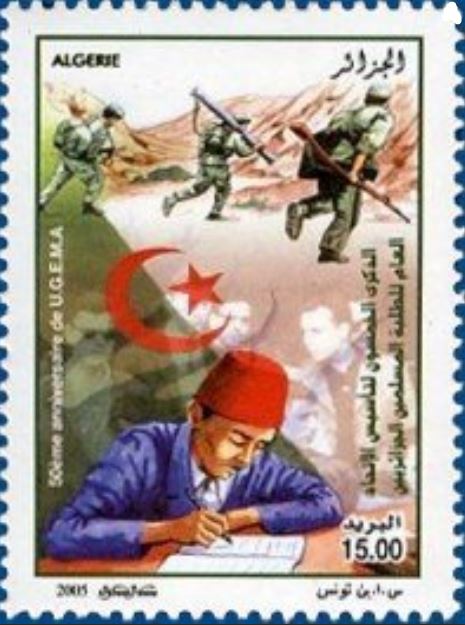
50th Anniversary of the General Union of Algerian Muslim Students UGEMA
The appearance of this student organization did not happen out of nowhere. Its origins and roots date back to the 1920s, thanks to the efforts of the first students who grew up within the national movement, nourished by its ideas and having faith in its principles.
Despite the pressures exerted by the colonial reality, this did not prevent the Algerian student from reflecting and aspiring to change his social, cultural, economic and political conditions and from trying to impose his existence through the creation of associations and organizations allowing him to demonstrate his possibilities and channel his energies in order to realize his aspirations as well as his prospective vision.
The political and military developments experienced by Algeria as well as the dramatic situation experienced by the Algerian student constituted the basis of a reflection aimed at setting up an organization through which students could defend their material and moral interests everywhere.
This is how the General Union of Algerian Muslim Students was born in July 1955, six months after the start of the liberation struggle.
Among the founding members, we will cite the student Abdesselam Belaïd, Ahmed Taleb al Ibrahimi, Mohammed Benyahia, Aissa Messaoudi, Mohamed Menouar Merrouche, Abdelhamid Mehri and among the martyrs, Taleb Abderrahmane, Benzerdjeb, Benbaâtouche, Amara Lounis Mohamed.
The objectives sought through the creation of UGEMA lie in the following points:
1- The defense of the material and moral interests of all Algerian students wherever they are.
2- Unification of student orientation in a single student movement.
3- Link the future of the Algerian intellectual to that of its people in struggle so as to eliminate all the distinctions induced by French academic traditions.
4- Need for the Algerian student to assume his historical and civilizational responsibility with regard to the fight of his people and counter French propaganda claiming that the Algerian Revolution is only the work of a band of criminals and brigands and that it is of external inspiration, aiming to destabilize the French presence in North Africa.
The UGEMA began its political and militant activity in March 1956 with the holding of its second congress in Paris. During this congress, a certain number of resolutions were adopted, the most important of which were the overall position regarding the liberation struggle and the fight of the Algerians, since the congress participants had claimed the independence of Algeria unconditionally and asked the French government to open negotiations with the National Liberation Front.
In response to the measures taken by the French Ministry of the Interior against student leaders and all Algerian students present on French soil, Algerian students decided to take up the challenge against the colonial apparatus. This is how the general strike was decided.
The decision to strike aroused the surprise and admiration of intellectual circles around the world and demonstrated the sincere solidarity of the Algerian student with the Algerian people who were enduring martyrdom. It also revealed the Algerian student's willingness to enter the field of armed struggle.
Indeed, the strike had achieved the expected objectives and which had been defined in the strike call issued by the Union. During the strike, the vanguards of the students had begun to join the maquis and the Revolution was thus able to benefit from the scientific skills and specialties brought by the students who had joined its ranks.
One of the first steps taken by Algerian students was to acquire international recognition through their presence at all international events to explain the question of their people and defend the interests of the Revolution and its objectives. Among these was the Sixth World Students' Conference in Colombo to which the Union was admitted as a delegate member.
Just as the Union had won recognition and admission as a member of the Eastern World Organization.
Far from limiting itself to this, the Union intensified its efforts with the world student federations in Switzerland as well as in Holland, in Germany, in Italy, in China, in America and in the Arab capitals, explaining the Algerian question in these countries and capitals with a view to obtaining their sympathy and support.
The French colonial administration did not remain idle in the face of the resounding successes of which the Algerian question had begun to reap the fruits through international solidarity and support, thanks to the efforts of the Union.
The administration and through it, the Ministry of the Interior, did not take long to pronounce the decision to dissolve the UGEMA on 01/28/1958. Not content with this, she proceeded to arrest the students who were subjected to interrogations, and suffered all kinds of torture before being thrown into French jails.
According to the terms of the decision of the Ministry of the Interior, the Union had deviated from its objectives and had begun to execute the orders and directives of the National Liberation Front.
The decision to dissolve the UGEMA sparked a large wave of protest on an international scale, particularly among the global student community. International solidarity with the Union was manifested during the extraordinary conference in London in April 1958 which was attended by a large number of national and international organizations and during which the organization of a week of solidarity with Algerian students was decided.
Despite the pressures exerted by the colonial reality, this did not prevent the Algerian student from reflecting and aspiring to change his social, cultural, economic and political conditions and from trying to impose his existence through the creation of associations and organizations allowing him to demonstrate his possibilities and channel his energies in order to realize his aspirations as well as his prospective vision.
The political and military developments experienced by Algeria as well as the dramatic situation experienced by the Algerian student constituted the basis of a reflection aimed at setting up an organization through which students could defend their material and moral interests everywhere.
This is how the General Union of Algerian Muslim Students was born in July 1955, six months after the start of the liberation struggle.
Among the founding members, we will cite the student Abdesselam Belaïd, Ahmed Taleb al Ibrahimi, Mohammed Benyahia, Aissa Messaoudi, Mohamed Menouar Merrouche, Abdelhamid Mehri and among the martyrs, Taleb Abderrahmane, Benzerdjeb, Benbaâtouche, Amara Lounis Mohamed.
The objectives sought through the creation of UGEMA lie in the following points:
1- The defense of the material and moral interests of all Algerian students wherever they are.
2- Unification of student orientation in a single student movement.
3- Link the future of the Algerian intellectual to that of its people in struggle so as to eliminate all the distinctions induced by French academic traditions.
4- Need for the Algerian student to assume his historical and civilizational responsibility with regard to the fight of his people and counter French propaganda claiming that the Algerian Revolution is only the work of a band of criminals and brigands and that it is of external inspiration, aiming to destabilize the French presence in North Africa.
The UGEMA began its political and militant activity in March 1956 with the holding of its second congress in Paris. During this congress, a certain number of resolutions were adopted, the most important of which were the overall position regarding the liberation struggle and the fight of the Algerians, since the congress participants had claimed the independence of Algeria unconditionally and asked the French government to open negotiations with the National Liberation Front.
In response to the measures taken by the French Ministry of the Interior against student leaders and all Algerian students present on French soil, Algerian students decided to take up the challenge against the colonial apparatus. This is how the general strike was decided.
The decision to strike aroused the surprise and admiration of intellectual circles around the world and demonstrated the sincere solidarity of the Algerian student with the Algerian people who were enduring martyrdom. It also revealed the Algerian student's willingness to enter the field of armed struggle.
Indeed, the strike had achieved the expected objectives and which had been defined in the strike call issued by the Union. During the strike, the vanguards of the students had begun to join the maquis and the Revolution was thus able to benefit from the scientific skills and specialties brought by the students who had joined its ranks.
One of the first steps taken by Algerian students was to acquire international recognition through their presence at all international events to explain the question of their people and defend the interests of the Revolution and its objectives. Among these was the Sixth World Students' Conference in Colombo to which the Union was admitted as a delegate member.
Just as the Union had won recognition and admission as a member of the Eastern World Organization.
Far from limiting itself to this, the Union intensified its efforts with the world student federations in Switzerland as well as in Holland, in Germany, in Italy, in China, in America and in the Arab capitals, explaining the Algerian question in these countries and capitals with a view to obtaining their sympathy and support.
The French colonial administration did not remain idle in the face of the resounding successes of which the Algerian question had begun to reap the fruits through international solidarity and support, thanks to the efforts of the Union.
The administration and through it, the Ministry of the Interior, did not take long to pronounce the decision to dissolve the UGEMA on 01/28/1958. Not content with this, she proceeded to arrest the students who were subjected to interrogations, and suffered all kinds of torture before being thrown into French jails.
According to the terms of the decision of the Ministry of the Interior, the Union had deviated from its objectives and had begun to execute the orders and directives of the National Liberation Front.
The decision to dissolve the UGEMA sparked a large wave of protest on an international scale, particularly among the global student community. International solidarity with the Union was manifested during the extraordinary conference in London in April 1958 which was attended by a large number of national and international organizations and during which the organization of a week of solidarity with Algerian students was decided.