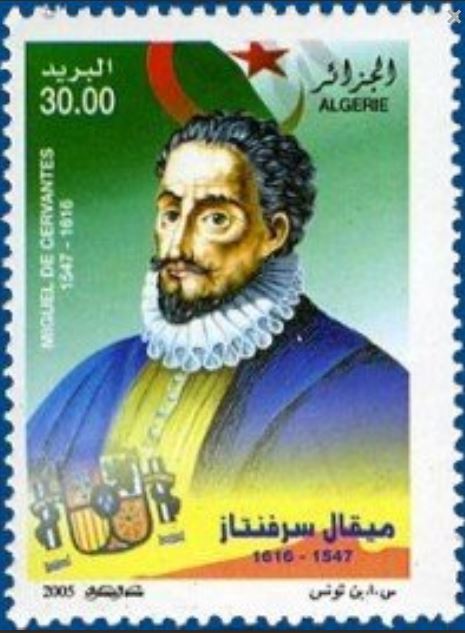
Portrait of Miguel De Cervantes
Miguel De Cervantes Saavedra was born on September 29, 1547, in the small town of Alcala, about thirty kilometers from Madrid.
The son of a modest doctor, he grew up in the middle of a large family. While still a student in Madrid in 1568, he published some poems in memory of the Queen of Spain.
In 1569 he left for Rome and the following year entered the service of Cardinal Giulio Acquaviva. Intoxicated with heroic dreams, he then joined a regiment of the Spanish army based in Naples.
In 1571, he took part in the naval battle of Lepanto against the Turks, during which he lost his left hand, earning him the nickname "Lepanto penguin".
In September 1575, while returning to Spain, Cervantes was kidnapped by Barbary pirates and taken captive to Algeria. He remained a prisoner for five years, and attempted to escape from Oran and Algiers several times. He was only redeemed and released on October 24, 1580 for 500 gold crowns of the Kings of Spain. It should be noted that the regency of Algiers, recognizing the quality and price of the character, gave him the benefit of a regime of favors, and despite his attempted escapes, the Dey of Algiers always showed him consideration even if once he was sentenced to 05 years of imprisonment.
It was in a cave east of Algiers near the shore that he found refuge for a while during his escape in 1579. Cervantes was 33 years old when he returned to Spain. The exceptional courage that he had shown during these years spent in the service of the homeland and during his Algerian adventure did not allow him to find a job within a family of the nobility. He then devoted himself to writing between 1582 and 1585, and produced poems and plays which have almost all disappeared today. In Madrid, he frequented literary circles. Also, he acquired a certain notoriety thanks to a pastoral novel “La Galatea”, the writing of which began in Algiers, without being able to make a living from his pen.
On December 12, 1584, he married the daughter of an owner of Esquivias. He was entrusted with modest government responsibilities such as supplying the fleet of the invincible Armada or collecting taxes. During his last position, he was suspected of embezzlement and was imprisoned by the authorities on several occasions. It was during his period of detention that he imagined the story of a knight-errant in search of superb exploits. This story gave rise to a story, the first part of which appeared in 1605 under the title “the ingenious Hidalgo don Quixote of La Mancha”.
Eight years later, Cervantes published “New Exemplary Stories”, a collection of twelve stories, and in 1614, he wrote “The Journey to Parnassus” which is probably his most intimate text. This work was followed, in 1615, by the second part of Don Quixote.
Finally, giving in to the heroic dreams of his youth, Cervantes completed a novel of fantastic chivalry four days before his death.
Miguel De Cervantes died in Madrid on Saturday April 23, 1616 and was buried in the convent on Calle del Humilladero.
The son of a modest doctor, he grew up in the middle of a large family. While still a student in Madrid in 1568, he published some poems in memory of the Queen of Spain.
In 1569 he left for Rome and the following year entered the service of Cardinal Giulio Acquaviva. Intoxicated with heroic dreams, he then joined a regiment of the Spanish army based in Naples.
In 1571, he took part in the naval battle of Lepanto against the Turks, during which he lost his left hand, earning him the nickname "Lepanto penguin".
In September 1575, while returning to Spain, Cervantes was kidnapped by Barbary pirates and taken captive to Algeria. He remained a prisoner for five years, and attempted to escape from Oran and Algiers several times. He was only redeemed and released on October 24, 1580 for 500 gold crowns of the Kings of Spain. It should be noted that the regency of Algiers, recognizing the quality and price of the character, gave him the benefit of a regime of favors, and despite his attempted escapes, the Dey of Algiers always showed him consideration even if once he was sentenced to 05 years of imprisonment.
It was in a cave east of Algiers near the shore that he found refuge for a while during his escape in 1579. Cervantes was 33 years old when he returned to Spain. The exceptional courage that he had shown during these years spent in the service of the homeland and during his Algerian adventure did not allow him to find a job within a family of the nobility. He then devoted himself to writing between 1582 and 1585, and produced poems and plays which have almost all disappeared today. In Madrid, he frequented literary circles. Also, he acquired a certain notoriety thanks to a pastoral novel “La Galatea”, the writing of which began in Algiers, without being able to make a living from his pen.
On December 12, 1584, he married the daughter of an owner of Esquivias. He was entrusted with modest government responsibilities such as supplying the fleet of the invincible Armada or collecting taxes. During his last position, he was suspected of embezzlement and was imprisoned by the authorities on several occasions. It was during his period of detention that he imagined the story of a knight-errant in search of superb exploits. This story gave rise to a story, the first part of which appeared in 1605 under the title “the ingenious Hidalgo don Quixote of La Mancha”.
Eight years later, Cervantes published “New Exemplary Stories”, a collection of twelve stories, and in 1614, he wrote “The Journey to Parnassus” which is probably his most intimate text. This work was followed, in 1615, by the second part of Don Quixote.
Finally, giving in to the heroic dreams of his youth, Cervantes completed a novel of fantastic chivalry four days before his death.
Miguel De Cervantes died in Madrid on Saturday April 23, 1616 and was buried in the convent on Calle del Humilladero.