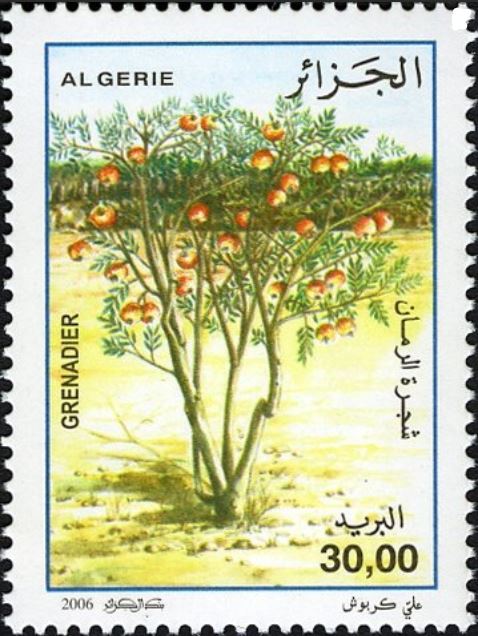
Pomegranate (Punica granatum)
National Tree Day
Pomegranate (Punica Granatum)
Shrub of the Punicaceae family, native to the Middle East, it is cultivated mainly for its fruits and for decoration.
The pomegranate tree can reach a size of 6 m, its shape is rounded with gray and reddish bark on the young branches, the leaves are simple and opposite, the red flowers bloom from May to September and its globular “pomegranate” fruits have a hard yellow to reddish skin. Inside the compartments separated by thin partitions hide a multitude of angular seeds, they are surrounded by a pink or red pulp, sweet and tangy. The pomegranate tree needs heat and appreciates sunny exposure; it does not grow in cold regions.
In Algeria, the pomegranate tree is mainly made up of two varieties: one from Messaad, located in southern Algeria, and the other from Koléa, located in the Mitidja plains. The planted area reached 10,368 hectares in 2004 with a production of 398,050 quintals.
Healing trees
The pomegranate tree is one of these so-called healing trees which provide the material to make ointments, ointments, decoctions, porridges, purees and other potions that men have been able to invent over the generations to heal themselves. Building on this observation, scientists began to study the virtues of these trees, sometimes venerated, to distinguish their active ingredients and benefit modern pharmacopoeia. These healing trees have left their mark on medicine, such as the cinchona from which nivaquine originated, one of the first remedies against malaria, the yew from which taxol is today extracted to treat certain cancers, the willow which hides the principle of aspirin in its bark, and many others still widely used in traditional medicine, but sometimes unexploited by scientists.
Pomegranate (Punica Granatum)
Shrub of the Punicaceae family, native to the Middle East, it is cultivated mainly for its fruits and for decoration.
The pomegranate tree can reach a size of 6 m, its shape is rounded with gray and reddish bark on the young branches, the leaves are simple and opposite, the red flowers bloom from May to September and its globular “pomegranate” fruits have a hard yellow to reddish skin. Inside the compartments separated by thin partitions hide a multitude of angular seeds, they are surrounded by a pink or red pulp, sweet and tangy. The pomegranate tree needs heat and appreciates sunny exposure; it does not grow in cold regions.
In Algeria, the pomegranate tree is mainly made up of two varieties: one from Messaad, located in southern Algeria, and the other from Koléa, located in the Mitidja plains. The planted area reached 10,368 hectares in 2004 with a production of 398,050 quintals.
Healing trees
The pomegranate tree is one of these so-called healing trees which provide the material to make ointments, ointments, decoctions, porridges, purees and other potions that men have been able to invent over the generations to heal themselves. Building on this observation, scientists began to study the virtues of these trees, sometimes venerated, to distinguish their active ingredients and benefit modern pharmacopoeia. These healing trees have left their mark on medicine, such as the cinchona from which nivaquine originated, one of the first remedies against malaria, the yew from which taxol is today extracted to treat certain cancers, the willow which hides the principle of aspirin in its bark, and many others still widely used in traditional medicine, but sometimes unexploited by scientists.