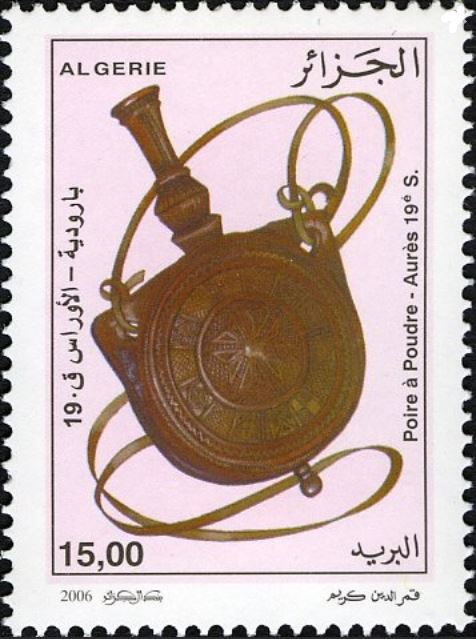
Powder Pear from Aurès 19th century
Case or powder magazine, it is often pear-shaped, trapezoidal or half-spherical. Its origin remains poorly known. The powder horn constitutes a necessary complement to the soldier's shoulder strap. It is probable that the oldest were first made with natural horns, either from an ox or a goat's horn.
The little powder horns of the Arabs still repeat these shapes, horns of gazelles or other antelopes.
In addition to the horns, the powder horn was also made of various materials: wood, ivory, iron and was richly decorated and sometimes even covered in velvet.
It is equipped with a cord and several rings which allow it to be suspended either on the neck or on the right side of the rider, where it hangs from the belt of the sword, from the shoulder strap loaded with cartridges.
Its end cut in the shape of a small cannon allows it to directly load the soldier's rifle or pistol.
In Algeria, powder pears are generally lenticular, sometimes conical, in shape, made of carved wood.
Currently, they are used by the horsemen of the Aurès during fantasias.
Ivory
There are different types of ivory: green ivory – of superior quality – comes from a recently killed elephant. It constitutes less than a quarter of world production. Its origin influences its characteristics: ivory from Siam (Thailand) is whiter and softer than ivory from Africa which tends to fade (like ivory from Gabon) or yellow (like that from Cape Town). Dead ivory, harder and of lower quality, is taken from the carcasses. Fossil ivory, usually cracked, bluish in color, was mainly preserved in the frozen soil of northern Siberia. Made up of the tusks of Pleistocene mammoths, it gets its blue color from saturation in metallic salts. Ivory can also come from the hippopotamus, warthog, wild boar, narwhal or walrus.
The little powder horns of the Arabs still repeat these shapes, horns of gazelles or other antelopes.
In addition to the horns, the powder horn was also made of various materials: wood, ivory, iron and was richly decorated and sometimes even covered in velvet.
It is equipped with a cord and several rings which allow it to be suspended either on the neck or on the right side of the rider, where it hangs from the belt of the sword, from the shoulder strap loaded with cartridges.
Its end cut in the shape of a small cannon allows it to directly load the soldier's rifle or pistol.
In Algeria, powder pears are generally lenticular, sometimes conical, in shape, made of carved wood.
Currently, they are used by the horsemen of the Aurès during fantasias.
Ivory
There are different types of ivory: green ivory – of superior quality – comes from a recently killed elephant. It constitutes less than a quarter of world production. Its origin influences its characteristics: ivory from Siam (Thailand) is whiter and softer than ivory from Africa which tends to fade (like ivory from Gabon) or yellow (like that from Cape Town). Dead ivory, harder and of lower quality, is taken from the carcasses. Fossil ivory, usually cracked, bluish in color, was mainly preserved in the frozen soil of northern Siberia. Made up of the tusks of Pleistocene mammoths, it gets its blue color from saturation in metallic salts. Ivory can also come from the hippopotamus, warthog, wild boar, narwhal or walrus.