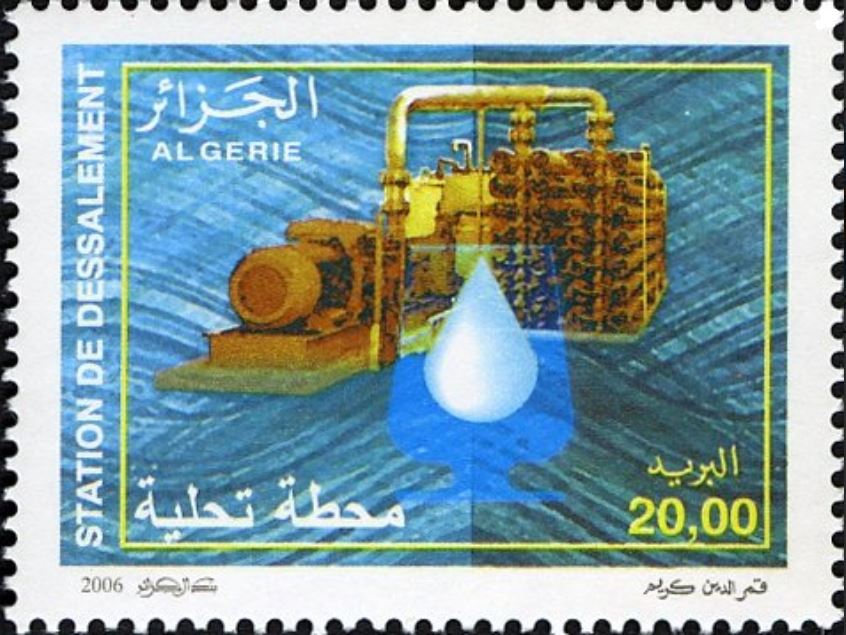
Seawater Desalination Plant
Seawater desalination is a technique for producing fresh water from seawater using processes to separate water and dissolved mineral salts.
Faced with the recurrence of drought cycles and signs of climate change, the desalination of sea water has been established, in Algeria, as one of the strategic axes of the national water policy in terms of mobilization and transfer of water resources.
In this context, seawater desalination aims to:
- Meet the water needs of cities and industrial activity zones located on the coastal fringe and in sub-coastal areas insufficiently endowed with water resources.
- Secure the water supply of large cities and industrial zones in the face of their growing needs.
- Exploit the natural asset that constitutes the availability of a perennial resource on a 1200 km coastline where 80% of the national population is concentrated.
- Expand the financing possibilities for major drinking water production projects thanks to various public-private partnership formulas.
The main seawater desalination technologies most often used are distillation and reverse osmosis.
Distillation involves evaporating seawater, either using the heat of the sun's rays or by heating it in a boiler. Only the water molecules escape, leaving the dissolved salts and all other substances contained in the seawater as a deposit. It is enough to condense the water vapor thus obtained to have consumable water.
As for reverse osmosis, it requires prior treatment of seawater by filtering and disinfecting it in order to eliminate suspended elements and the microorganisms it contains. This process then consists of applying sufficient pressure to this salt water to make it pass through a semi-permeable membrane: only the water molecules pass through this membrane, thus providing potable fresh water.
The largest station in Africa
The Hamma seawater desalination plant in Algiers is the largest membrane desalination plant in Africa. The project, which began in 2007, is made up of two main units: the Hamma seawater desalination station and the connection structures. Its daily production capacity is 200,000 m3, corresponding to 30% of drinking water consumption in the Algiers metropolitan area. It is a project whose impacts are long-term, as it should enable the capital to cover its drinking water needs for 25 years.
Faced with the recurrence of drought cycles and signs of climate change, the desalination of sea water has been established, in Algeria, as one of the strategic axes of the national water policy in terms of mobilization and transfer of water resources.
In this context, seawater desalination aims to:
- Meet the water needs of cities and industrial activity zones located on the coastal fringe and in sub-coastal areas insufficiently endowed with water resources.
- Secure the water supply of large cities and industrial zones in the face of their growing needs.
- Exploit the natural asset that constitutes the availability of a perennial resource on a 1200 km coastline where 80% of the national population is concentrated.
- Expand the financing possibilities for major drinking water production projects thanks to various public-private partnership formulas.
The main seawater desalination technologies most often used are distillation and reverse osmosis.
Distillation involves evaporating seawater, either using the heat of the sun's rays or by heating it in a boiler. Only the water molecules escape, leaving the dissolved salts and all other substances contained in the seawater as a deposit. It is enough to condense the water vapor thus obtained to have consumable water.
As for reverse osmosis, it requires prior treatment of seawater by filtering and disinfecting it in order to eliminate suspended elements and the microorganisms it contains. This process then consists of applying sufficient pressure to this salt water to make it pass through a semi-permeable membrane: only the water molecules pass through this membrane, thus providing potable fresh water.
The largest station in Africa
The Hamma seawater desalination plant in Algiers is the largest membrane desalination plant in Africa. The project, which began in 2007, is made up of two main units: the Hamma seawater desalination station and the connection structures. Its daily production capacity is 200,000 m3, corresponding to 30% of drinking water consumption in the Algiers metropolitan area. It is a project whose impacts are long-term, as it should enable the capital to cover its drinking water needs for 25 years.