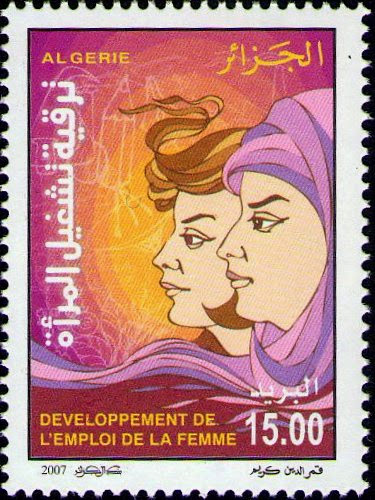
March 8 - Development of women's employment
The evolution of Algerian society has clearly enabled the emergence of women in the world of work. Indeed, due to the rapid changes recorded by the country over a long period, the Algerian economy and society have been led to integrate women into the development process by offering them real opportunities for emancipation and promotion.
As in the past when she had participated very early and fully in the struggle for national liberation and independence, she was also asked to fulfill a large number of roles and responsibilities within society and in particular in the world of work.
Today, these are professional sectors and activities that are almost entirely run by women; entire professional bodies have experienced an increase in the rate of feminization. The examples of the health, education, administration sectors in all its sovereign and public service components, branches of industry, the service sector in general, business creation perfectly illustrate this strong change in the world of work, despite the circumstances experienced by the job market in the recent past.
Social and cultural progress, the improvement in the level of education, schooling, the success rate in school, professional and baccalaureate exams, the proportion of women at university level and the adoption of new lifestyles and livelihoods have constituted favorable and structuring factors for integrating women into their role as creator of value and contributor to national wealth. It is necessary to underline the efforts made to gradually reduce the obstacles which slow down without, however, calling into question the strong trend of the mobilization of women and their growing impact on the job market and on the functioning of the structures of the economy and the country.
Some figures are necessary to understand the reality of this trend: the share of the female employed population in relation to the total employed population is 14%, an increase of almost 5 times compared to the period at the end of the 1970s and the beginning of the 2000s and of almost 2.5 times over the period at the end of the 1980s and the beginning of the 2000s.
The proportion of employed women with higher education doubled over the decade 1985-1996 and quadrupled compared to the early 2000s. The civil service is the largest employer of women since nearly 43% of employed women are public administration agents distributed between national education, health, communities, justice and security bodies. The institutions in charge of regulation and socio-economic monitoring are today gradually incorporating so-called gender approaches which aim to build strategies aiming as far as possible to ensure parity in treatment and equal opportunities between genders within society and the economy.
Society in general and the job market in particular will contribute to mobilizing all the resources available to the country, including those held by the female gender under the effect of strong growth, the only condition for being able to meet the challenges of rapid globalization and sustainable economic and social progress shared by all, without distinction of gender.
As in the past when she had participated very early and fully in the struggle for national liberation and independence, she was also asked to fulfill a large number of roles and responsibilities within society and in particular in the world of work.
Today, these are professional sectors and activities that are almost entirely run by women; entire professional bodies have experienced an increase in the rate of feminization. The examples of the health, education, administration sectors in all its sovereign and public service components, branches of industry, the service sector in general, business creation perfectly illustrate this strong change in the world of work, despite the circumstances experienced by the job market in the recent past.
Social and cultural progress, the improvement in the level of education, schooling, the success rate in school, professional and baccalaureate exams, the proportion of women at university level and the adoption of new lifestyles and livelihoods have constituted favorable and structuring factors for integrating women into their role as creator of value and contributor to national wealth. It is necessary to underline the efforts made to gradually reduce the obstacles which slow down without, however, calling into question the strong trend of the mobilization of women and their growing impact on the job market and on the functioning of the structures of the economy and the country.
Some figures are necessary to understand the reality of this trend: the share of the female employed population in relation to the total employed population is 14%, an increase of almost 5 times compared to the period at the end of the 1970s and the beginning of the 2000s and of almost 2.5 times over the period at the end of the 1980s and the beginning of the 2000s.
The proportion of employed women with higher education doubled over the decade 1985-1996 and quadrupled compared to the early 2000s. The civil service is the largest employer of women since nearly 43% of employed women are public administration agents distributed between national education, health, communities, justice and security bodies. The institutions in charge of regulation and socio-economic monitoring are today gradually incorporating so-called gender approaches which aim to build strategies aiming as far as possible to ensure parity in treatment and equal opportunities between genders within society and the economy.
Society in general and the job market in particular will contribute to mobilizing all the resources available to the country, including those held by the female gender under the effect of strong growth, the only condition for being able to meet the challenges of rapid globalization and sustainable economic and social progress shared by all, without distinction of gender.