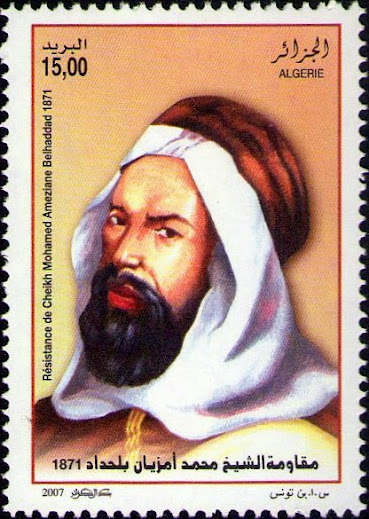
Resistance of Sheikh Mohamed Ameziane Belhaddad
Cheikh Mohamed Ameziane Belhaddad was born in the village of Seddouk Oufella around 1790. His father took care of his education and instruction, detecting in him signs of a great personality.
After acquiring some knowledge at the Koranic school that his father founded, the village medersa, he affiliated with the zaouïa of the chechtoula in Ait-smaïl (Boghni Tizi-ouzou), he devoted himself to the study of Sufism, he thus became Moqaddem of the Tarîqa Errahmania.
He returned to Seddouk where he was chosen by the population to be Imam and teacher at the mosque. His diligence in carrying out his missions made him the “khalif”, Supreme Sheikh, of Tarîqa Errahmania in 1857.
Cheikh Belhaddad always considered that the resistance and struggle of the Algerian people were necessary but always considered that it was necessary to prepare seriously beforehand. For him, throwing populations into unequal battles against colonialist forces would expose the Algerian people to fatal extermination.
On April 8, 1871, helped by his children, he went to the Seddouk market where a huge crowd was waiting for him to listen to him say at the end of his speech this phrase that has become famous "with the will of God, we will throw the colonists into the sea as I throw my cane to the ground", joining the gesture to the words, he threw it in front of this angry crowd.
He raised an army that French officers of the time estimated between 150,000 and 200,000 combatants, while Algerian sources estimated it at 300,000 men. He entrusted command of these troops to his two sons. The two took the lead in a real resistance and fought fiercely.
On July 13, 1871, Cheikh Mohamed-Ameziane Belhaddad was placed under house arrest in Seddouk by the colonial administration to be taken on July 18, 1871 to Bordj-Moussa (current Béjaia museum), then to the military court of Constantine which sentenced him to five years in prison, he died on April 29, 1873 in prison. of El-Koudiat (Constantine) at the age of 83.
Although he had insistently expressed the wish to be buried in his native village, the colonial administration deprived him of this last wish. He was buried by the local population and followers of Tarîqa Errahmania in the central cemetery of Constantine.
After acquiring some knowledge at the Koranic school that his father founded, the village medersa, he affiliated with the zaouïa of the chechtoula in Ait-smaïl (Boghni Tizi-ouzou), he devoted himself to the study of Sufism, he thus became Moqaddem of the Tarîqa Errahmania.
He returned to Seddouk where he was chosen by the population to be Imam and teacher at the mosque. His diligence in carrying out his missions made him the “khalif”, Supreme Sheikh, of Tarîqa Errahmania in 1857.
Cheikh Belhaddad always considered that the resistance and struggle of the Algerian people were necessary but always considered that it was necessary to prepare seriously beforehand. For him, throwing populations into unequal battles against colonialist forces would expose the Algerian people to fatal extermination.
On April 8, 1871, helped by his children, he went to the Seddouk market where a huge crowd was waiting for him to listen to him say at the end of his speech this phrase that has become famous "with the will of God, we will throw the colonists into the sea as I throw my cane to the ground", joining the gesture to the words, he threw it in front of this angry crowd.
He raised an army that French officers of the time estimated between 150,000 and 200,000 combatants, while Algerian sources estimated it at 300,000 men. He entrusted command of these troops to his two sons. The two took the lead in a real resistance and fought fiercely.
On July 13, 1871, Cheikh Mohamed-Ameziane Belhaddad was placed under house arrest in Seddouk by the colonial administration to be taken on July 18, 1871 to Bordj-Moussa (current Béjaia museum), then to the military court of Constantine which sentenced him to five years in prison, he died on April 29, 1873 in prison. of El-Koudiat (Constantine) at the age of 83.
Although he had insistently expressed the wish to be buried in his native village, the colonial administration deprived him of this last wish. He was buried by the local population and followers of Tarîqa Errahmania in the central cemetery of Constantine.