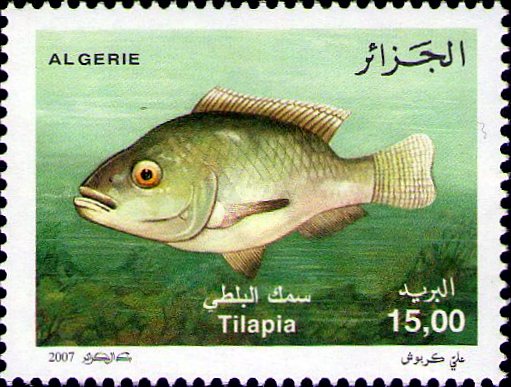
Tilapia
Saharan Aquaculture
The first conclusive experiments in breeding warm water fish in Algeria give hope for an interesting future for the development of Saharan aquaculture. Aquaculture in southern Algeria concerns the exploitation of natural resources of animal origin evolving in the chotts, the cultivation of algae in alkaline environments and the breeding of freshwater and warm water fish which mainly focuses on tilapia nilotica (Oreochromis niloticus) as the species best adapted to Saharan ecological conditions. Tilapia is a fish native to Africa and the Middle East. It was introduced to parts of Asia for breeding purposes and is now traded in most parts of the world. This fish belongs to the cichlid family of the order Perciformes. The tilapia genus includes approximately fifteen species. It is characterized as follows:
- Head with a single nostril on each side.
- Non-spinous opercular bone.
- Laterally compressed body, covered mainly with cycloid scales and sometimes with ctenoid scales.
- Long dorsal fin with spiny front part.
- Anal fin with at least the first three spiny rays.
Tilapia measure on average 10 to 30 cm long and live in waters whose temperature is generally between 20 and 28°C. Some are able to survive in waters where the oxygen content is particularly low.
The tilapia diet consists of plants and organic detritus present in the water, but also insect larvae, small crustaceans or worms.
Tilapia are prolific and they incubate their young in their mouths only to spit them out when they are formed. Tilapia flesh is white, firm and lean. Its texture is moist and its taste is delicate.
In the south of Algeria, the development of tilapia farming, among other aquaculture sectors, makes it possible to:
- develop the water potential represented by existing boreholes, initially planned for agricultural irrigation then abandoned due to salinity of the water.
- use canals and agricultural irrigation basins by integrating fish farming with agricultural activities, and integrate fish farming in oases in order to make them more profitable and preserve the oasis space.
The first conclusive experiments in breeding warm water fish in Algeria give hope for an interesting future for the development of Saharan aquaculture. Aquaculture in southern Algeria concerns the exploitation of natural resources of animal origin evolving in the chotts, the cultivation of algae in alkaline environments and the breeding of freshwater and warm water fish which mainly focuses on tilapia nilotica (Oreochromis niloticus) as the species best adapted to Saharan ecological conditions. Tilapia is a fish native to Africa and the Middle East. It was introduced to parts of Asia for breeding purposes and is now traded in most parts of the world. This fish belongs to the cichlid family of the order Perciformes. The tilapia genus includes approximately fifteen species. It is characterized as follows:
- Head with a single nostril on each side.
- Non-spinous opercular bone.
- Laterally compressed body, covered mainly with cycloid scales and sometimes with ctenoid scales.
- Long dorsal fin with spiny front part.
- Anal fin with at least the first three spiny rays.
Tilapia measure on average 10 to 30 cm long and live in waters whose temperature is generally between 20 and 28°C. Some are able to survive in waters where the oxygen content is particularly low.
The tilapia diet consists of plants and organic detritus present in the water, but also insect larvae, small crustaceans or worms.
Tilapia are prolific and they incubate their young in their mouths only to spit them out when they are formed. Tilapia flesh is white, firm and lean. Its texture is moist and its taste is delicate.
In the south of Algeria, the development of tilapia farming, among other aquaculture sectors, makes it possible to:
- develop the water potential represented by existing boreholes, initially planned for agricultural irrigation then abandoned due to salinity of the water.
- use canals and agricultural irrigation basins by integrating fish farming with agricultural activities, and integrate fish farming in oases in order to make them more profitable and preserve the oasis space.