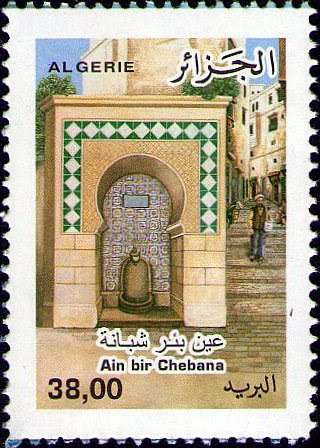
Ain Chebana Fountain
The fountains of the city of Algiers allowed residents to obtain water supplies. It was, in addition to the cisterns and wells which were private property, a necessary addition to the well-being of the population. They were an essential element of urban architecture and could even give their name to a district of the city. The various authors agree that there were more than a hundred of them and they were scattered throughout all the neighborhoods, not counting those found in barracks, palaces and mosques. They served as a beneficial stopover for those climbing to the top of the casbah. These fountains were supplied with water by the sources which were at the origin of the agglomeration of Algiers.
When Algiers was equipped with aqueducts sufficient to supply the city with water, the city councilors and notables competed in the construction of these fountains thanks to their donations. Thus, a dozen fountains were built or restored by Ali Pasha between 1759 and 1765, after the earthquake which shook Algiers in 1755, and which had shifted the flow of the water tables and damaged the pipes. These fountains have disappeared today and for many of them, we do not know their location. All that remains is the founding inscriptions kept at the National Museum of Antiquities in Algiers and brought there during the demolition and development work on arteries in the historic city. Some of these fountains were decorated with inscriptions and earthenware tiles. The most beautiful ones were in the shape of arches, most often leaning against a building. They were decorated with marble or tuff columns. Others, more modest, had the shape of a niche with a semicircular arch. These fountains had professional users. The water carriers, (El Guerraba), who wandered through the alleys of the souk and who offered thirsty passers-by a cup of fresh water scented with cade oil, for a small coin.
When Algiers was equipped with aqueducts sufficient to supply the city with water, the city councilors and notables competed in the construction of these fountains thanks to their donations. Thus, a dozen fountains were built or restored by Ali Pasha between 1759 and 1765, after the earthquake which shook Algiers in 1755, and which had shifted the flow of the water tables and damaged the pipes. These fountains have disappeared today and for many of them, we do not know their location. All that remains is the founding inscriptions kept at the National Museum of Antiquities in Algiers and brought there during the demolition and development work on arteries in the historic city. Some of these fountains were decorated with inscriptions and earthenware tiles. The most beautiful ones were in the shape of arches, most often leaning against a building. They were decorated with marble or tuff columns. Others, more modest, had the shape of a niche with a semicircular arch. These fountains had professional users. The water carriers, (El Guerraba), who wandered through the alleys of the souk and who offered thirsty passers-by a cup of fresh water scented with cade oil, for a small coin.