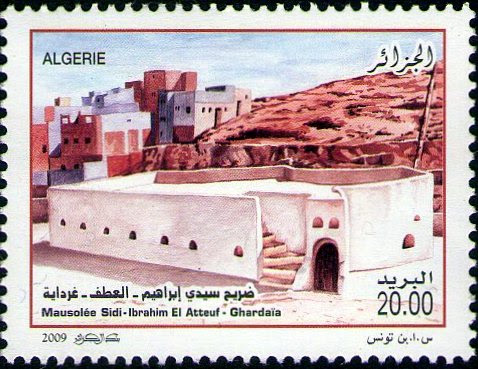
Sidi Ibrahim Mausoleum, El Atteuf Ghardaïa
Sheikh Ibrahim Ibn Manade is part of the learned people of the 500s of the Hegira. Considered one of the most important scholars of El Atteuf at the time, he is of Zenet origin (Berbers who inhabited North Africa). He was credited with many achievements in the field of social cohesion. To this end, it occupies a special place in people's memories.
South of Ksar El Atteuf is the mausoleum of Sidi Ibrahim, inside one of the oldest cemeteries in the Oued M'zab region. The mausoleum is made up of a small rounded room, half of which is sunk into the ground and constitutes the core of the construction. It is in this room, which was later enlarged, that the Sheikh provided teaching. The building, of simple architectural form, is characterized by bright colors. The mausoleum opens onto an esplanade with arcades of different shapes. These arcades have a certain height and are in harmony with the various openings and so many shapes made above the large stalls, built on the exterior facades of the walls of the Sheikh's tomb. The manufacturing techniques of the mausoleum are characterized by the use of local materials such as stone cemented with a mixture of lime and sand for the construction of load-bearing walls, as well as the use of palm tree trunks as a paving frame for the roof of the arcades.
This architectural work has continued to inspire many renowned researchers and artists, such as Le Corbusier who designed the chapel of Ronchamp, in France, and which has been classified as a world work.
South of Ksar El Atteuf is the mausoleum of Sidi Ibrahim, inside one of the oldest cemeteries in the Oued M'zab region. The mausoleum is made up of a small rounded room, half of which is sunk into the ground and constitutes the core of the construction. It is in this room, which was later enlarged, that the Sheikh provided teaching. The building, of simple architectural form, is characterized by bright colors. The mausoleum opens onto an esplanade with arcades of different shapes. These arcades have a certain height and are in harmony with the various openings and so many shapes made above the large stalls, built on the exterior facades of the walls of the Sheikh's tomb. The manufacturing techniques of the mausoleum are characterized by the use of local materials such as stone cemented with a mixture of lime and sand for the construction of load-bearing walls, as well as the use of palm tree trunks as a paving frame for the roof of the arcades.
This architectural work has continued to inspire many renowned researchers and artists, such as Le Corbusier who designed the chapel of Ronchamp, in France, and which has been classified as a world work.