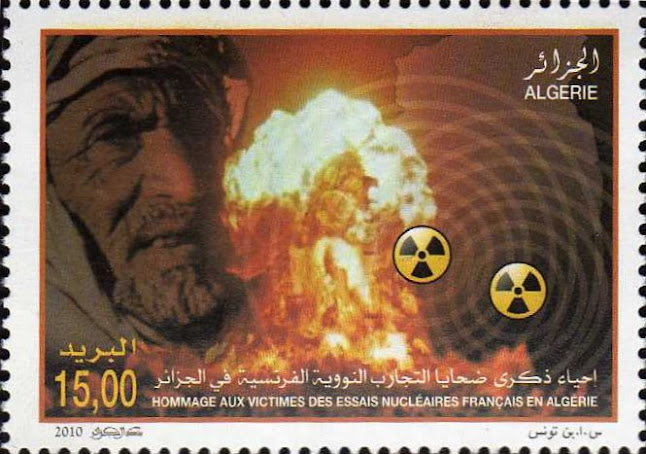
Tribute to the victims of French nuclear tests
Used as a weapon of military deterrence, nuclear power has been the subject of incessant research since its discovery.
Competition was in full swing between the superpowers, which, freeing up colossal budgets, launched research into uranium and plutonium to produce the bombs of the same name.
The cities of Hiroshima and Nagasaki, in Japan, paid the price respectively on August 6 and 9, 1945 to general dismay after the dropping of the first atomic bombs by the United States.
It was then France's turn to launch into nuclear power by experimenting with a bomb more destructive and more devastating than the previous ones. The H (Hydrogen) bomb exploded for the first time in the atmosphere on February 13, 1960, in Reggane, in the Algerian Sahara. Underground tests also took place at In Ecker. A total of 57 tests were carried out, according to the count known to date.
The 40,000 inhabitants living in the region in question suffered the effects of local contamination, radioactivity in water and food products. The harmful effects of nuclear power were then minimized by the French government, but the fight led by various associations supported by symposia and conferences ended up bearing fruit, since the principle of compensation for victims was finally taken into account.
The International Atomic Energy Agency (IAEA), in 1999, at the request of Algeria, carried out an evaluation mission to the regions where the tests were carried out, recommended that the sites in question be prohibited from access.
A financial envelope is released by the former colonial power, for compensation of victims under the control of a UN body. The superpowers prefer to keep nuclear power more than ever as a weapon of deterrence and supremacy over other nations of the world.
All efforts should converge, at the start of this new century, in favor of the elimination of nuclear weapons from the planet so that it is no longer an illusion.
Competition was in full swing between the superpowers, which, freeing up colossal budgets, launched research into uranium and plutonium to produce the bombs of the same name.
The cities of Hiroshima and Nagasaki, in Japan, paid the price respectively on August 6 and 9, 1945 to general dismay after the dropping of the first atomic bombs by the United States.
It was then France's turn to launch into nuclear power by experimenting with a bomb more destructive and more devastating than the previous ones. The H (Hydrogen) bomb exploded for the first time in the atmosphere on February 13, 1960, in Reggane, in the Algerian Sahara. Underground tests also took place at In Ecker. A total of 57 tests were carried out, according to the count known to date.
The 40,000 inhabitants living in the region in question suffered the effects of local contamination, radioactivity in water and food products. The harmful effects of nuclear power were then minimized by the French government, but the fight led by various associations supported by symposia and conferences ended up bearing fruit, since the principle of compensation for victims was finally taken into account.
The International Atomic Energy Agency (IAEA), in 1999, at the request of Algeria, carried out an evaluation mission to the regions where the tests were carried out, recommended that the sites in question be prohibited from access.
A financial envelope is released by the former colonial power, for compensation of victims under the control of a UN body. The superpowers prefer to keep nuclear power more than ever as a weapon of deterrence and supremacy over other nations of the world.
All efforts should converge, at the start of this new century, in favor of the elimination of nuclear weapons from the planet so that it is no longer an illusion.