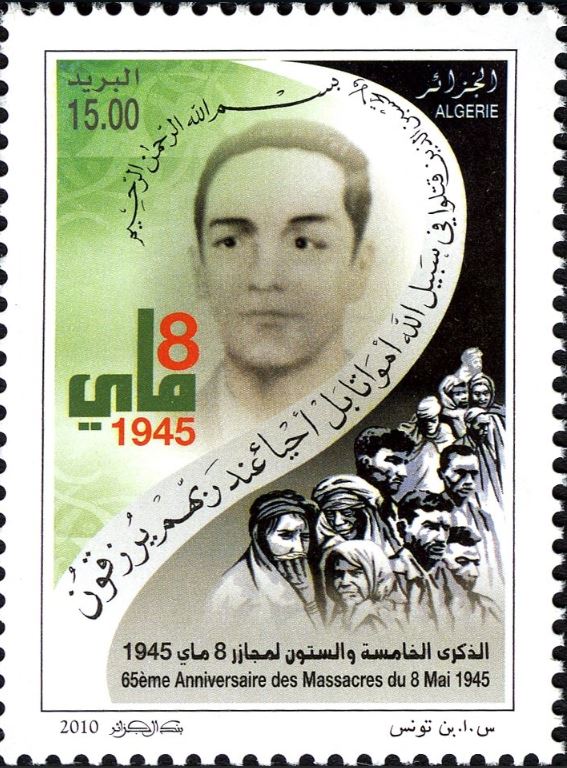
65th Anniversary of the Massacres of May 8, 1945
May 8, 1945 will remain in the memory of Algerians a black page of French colonialism, which history has never sufficiently condemned and which the authors have never really recognized.
It was preceded by the peaceful demonstrations of May 1, 1945 intended to draw the attention of the colonial authority to promises made on the eve of the Second World War and which it seemed to have forgotten; they were harshly repressed.
The political leaders, Messali Hadj, leader of the Algerian Popular Party (PPA), then in prison and Ferhat Abbas, future first President of the Provisional Government of the Algerian Republic (GPRA) had called for the celebration of May 8, 1945, the day of the Allied victory over Nazism, in which the Algerians took part alongside French soldiers, with a parade in Sétif and Guelma. But an Algerian flag and signs demanding the release of Messali Hadj and the independence of Algeria were also displayed. The young scout, Bouzid Saal, who had waved the Algerian flag, was shot dead by a police officer. Fact which will trigger violent riots among the demonstrators.
The insurrection will spread to neighboring towns, Guelma, Constantine and Kherrata. The repression will be immediate and extremely brutal. On May 9, the army, navy and air force will extend repression for six weeks in these regions, sparing neither women nor children, causing, according to official estimates in Algeria, nearly 45,000 deaths.
It is certain that the riots in Sétif, Guelma and Kherrata herald the war of independence. They influenced the awareness of an essential armed revolt and precipitated the nationalist movement's recourse to insurrection. They would therefore be the prelude to the war of national liberation launched nine years later by the National Liberation Front.
What these regions experienced in 1945 strongly resembles war crimes, or even crimes against humanity, even if this concept was born later. The term genocide was also used by Algerian politicians.
Habert Colin de Verdière, former French Ambassador to Algeria, on his way to Sétif and in front of an audience of students, recognized the reality of the massacres, a recognition considered insufficient in Algeria.
Today, commemorative steles erected in the affected towns remind posterity of the horror experienced and how these events were decisive for the continuation of the French occupation in Algeria.
It was preceded by the peaceful demonstrations of May 1, 1945 intended to draw the attention of the colonial authority to promises made on the eve of the Second World War and which it seemed to have forgotten; they were harshly repressed.
The political leaders, Messali Hadj, leader of the Algerian Popular Party (PPA), then in prison and Ferhat Abbas, future first President of the Provisional Government of the Algerian Republic (GPRA) had called for the celebration of May 8, 1945, the day of the Allied victory over Nazism, in which the Algerians took part alongside French soldiers, with a parade in Sétif and Guelma. But an Algerian flag and signs demanding the release of Messali Hadj and the independence of Algeria were also displayed. The young scout, Bouzid Saal, who had waved the Algerian flag, was shot dead by a police officer. Fact which will trigger violent riots among the demonstrators.
The insurrection will spread to neighboring towns, Guelma, Constantine and Kherrata. The repression will be immediate and extremely brutal. On May 9, the army, navy and air force will extend repression for six weeks in these regions, sparing neither women nor children, causing, according to official estimates in Algeria, nearly 45,000 deaths.
It is certain that the riots in Sétif, Guelma and Kherrata herald the war of independence. They influenced the awareness of an essential armed revolt and precipitated the nationalist movement's recourse to insurrection. They would therefore be the prelude to the war of national liberation launched nine years later by the National Liberation Front.
What these regions experienced in 1945 strongly resembles war crimes, or even crimes against humanity, even if this concept was born later. The term genocide was also used by Algerian politicians.
Habert Colin de Verdière, former French Ambassador to Algeria, on his way to Sétif and in front of an audience of students, recognized the reality of the massacres, a recognition considered insufficient in Algeria.
Today, commemorative steles erected in the affected towns remind posterity of the horror experienced and how these events were decisive for the continuation of the French occupation in Algeria.