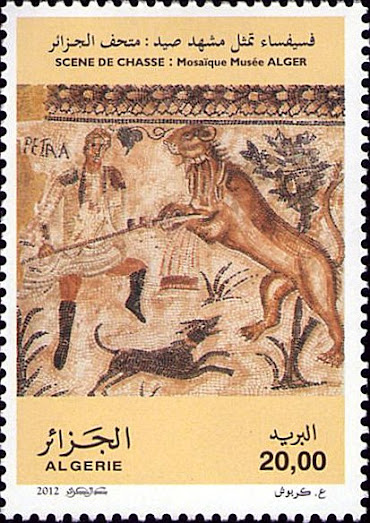
Hunting scene - Algiers Museum
Roman art gave pride of place to mosaics, placed on ceilings, walls but especially on the floor. This technique consists of creating compositions based on small cubes of stones of different colors or, more rarely, brick or glass called tesserae. The tesserae are placed on a preparation of fresh mortar which solidifies as it dries.
Mosaic developed throughout the Roman Empire, where each province highlighted its particularities. African workshops, particularly those from Algeria, prefer polychrome compositions with a marked taste for everyday scenes, hunting scenes or mythological scenes.
Hunting scene (4th century): Mosaic found in Ténès and stored at the National Museum of Antiquities in Algiers. It measures 2.34 m x 2m. It illustrates a hunter, equipped with a spear, accompanied by his dog who is preparing to fight with a lion.
Mosaic of the Muses: It is a large mosaic composed of nine medallions, it measures 9.23m in length and 4.5m in width. This mosaic which has benefited from restoration work is exhibited at the old Cherchell museum.
In mythology, the muses are the goddesses of art, each representing a particular art: history, music, poetry, comedy, tragedy, dance, elegy, astronomy and eloquence.
Mosaic developed throughout the Roman Empire, where each province highlighted its particularities. African workshops, particularly those from Algeria, prefer polychrome compositions with a marked taste for everyday scenes, hunting scenes or mythological scenes.
Hunting scene (4th century): Mosaic found in Ténès and stored at the National Museum of Antiquities in Algiers. It measures 2.34 m x 2m. It illustrates a hunter, equipped with a spear, accompanied by his dog who is preparing to fight with a lion.
Mosaic of the Muses: It is a large mosaic composed of nine medallions, it measures 9.23m in length and 4.5m in width. This mosaic which has benefited from restoration work is exhibited at the old Cherchell museum.
In mythology, the muses are the goddesses of art, each representing a particular art: history, music, poetry, comedy, tragedy, dance, elegy, astronomy and eloquence.