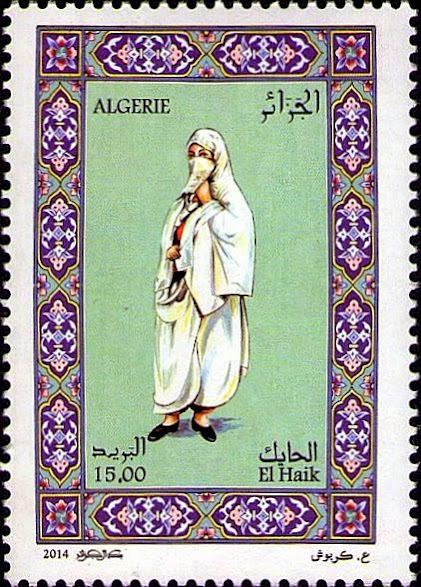
El haik
The drape as opposed to the fitted suit has neither shape nor seam. Contrary to popular belief, the veil as a draped garment is not the prerogative of Muslim women; it was also worn by Christian and Jewish women. Often woven from wool, cotton or silk thread, its materials, colors and role change from one era to another, from one culture to another, from one region to another, from one social class to another and from one generation to another. the veil has different names in the Arab Maghreb countries: “Barakan” in Libya, “Sefsari” in Tunisia, “Haik” in Morocco and Algeria.
The veil is known in Algeria in several variations:
The Haik: according to the writings of certain travelers, the Haik saw its appearance in Algiers from the 17th century; it is a square drape of approximately 2 meters in ecru or white color which the woman surrounds the entire body. It varies depending on the material of the weave (wool, silk, synthetic) and can be worn either with a face veil: it is “Le Haik Bel ‘Ajar” as in Algiers and its surroundings; worn without “'Ajar” it is “Haik Bouaouina” which only reveals one eye as in Blida, Tlemcen, Oran; in the Ghardaia region the vernacular name is “Ahouli” or “Ghanbouze”.
The veil is known in Algeria in several variations:
The Haik: according to the writings of certain travelers, the Haik saw its appearance in Algiers from the 17th century; it is a square drape of approximately 2 meters in ecru or white color which the woman surrounds the entire body. It varies depending on the material of the weave (wool, silk, synthetic) and can be worn either with a face veil: it is “Le Haik Bel ‘Ajar” as in Algiers and its surroundings; worn without “'Ajar” it is “Haik Bouaouina” which only reveals one eye as in Blida, Tlemcen, Oran; in the Ghardaia region the vernacular name is “Ahouli” or “Ghanbouze”.