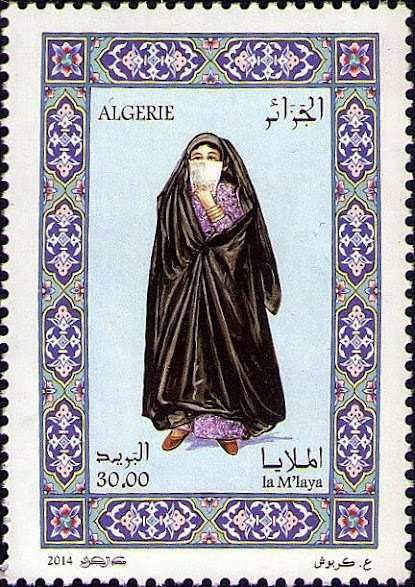
M’laya
The drape as opposed to the fitted suit has neither shape nor seam. Contrary to popular belief, the veil as a draped garment is not the prerogative of Muslim women; it was also worn by Christian and Jewish women. Often woven from wool, cotton or silk thread, its materials, colors and role change from one era to another, from one culture to another, from one region to another, from one social class to another and from one generation to another. the veil has different names in the Arab Maghreb countries: “Barakan” in Libya, “Sefsari” in Tunisia, “Haik” in Morocco and Algeria.
The veil is known in Algeria in several variations:
La M'laya: the women of Eastern Beylik decided in 1792 to wear, as a sign of ostentatious mourning, a long veil made of black cloth with which they covered their entire body, following the tragic death of Salah Bey who governed Constantine for 21 years. The latter was a fair, honest man and loved by the local population.
The Algerian veil symbolizes femininity, purity, it also represents Algerian identity.
The veil is known in Algeria in several variations:
La M'laya: the women of Eastern Beylik decided in 1792 to wear, as a sign of ostentatious mourning, a long veil made of black cloth with which they covered their entire body, following the tragic death of Salah Bey who governed Constantine for 21 years. The latter was a fair, honest man and loved by the local population.
The Algerian veil symbolizes femininity, purity, it also represents Algerian identity.