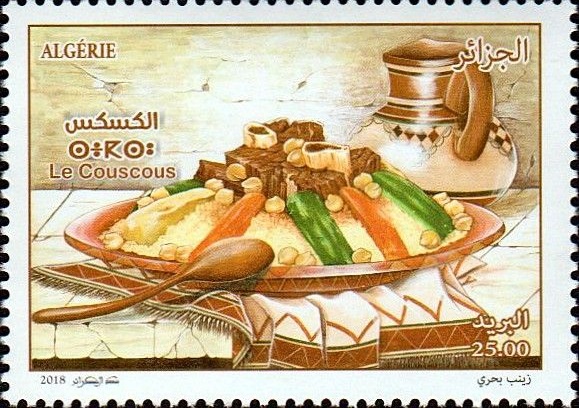
Couscous
An ancestral dish several thousand years old has resisted modernity, occupies a preponderant place in traditional Algerian cuisine. It is basically a seed obtained from semolina, and this is why the history of this dish is inseparable from the history of the most cultivated cereal in the world: wheat, since 7000 years BC.
Experts confirm that the origin and history of couscous dates back to the period 202-148 BC where they found the remains of pottery similar to the pots used in the preparation of couscous in tombs dating back to the reign of the Amazigh king Massinissa and during the Islamization of North Africa, the Arabs adopted it and we find the remains of the first known utensils in the Tiaret region, dating from the 9th century. century which resemble the main tool for cooking couscous: the couscous maker.
The word seksu (become kuskus, kuskusun) in North African Arabic, exists in all Algerian and North African dialects and designates well-shaped and well-rolled wheat, present in the life of the community on many occasions (festivity, marriage, circumcision, offerings, death, etc.).
Depending on the region, the word has several pronunciations, such as kseksu and seksu. In the east of the country, we invariably say cousksi, naâma and barbucha.
In Kabylia and as far as Algiers, it is called seksu etkseksou. In Mzab, we call couscous ouchou. In the west of the country, it is called taâm.
Couscous is the true national dish. There are a thousand and one ways to prepare it. In each region, its preparation, couscous is served with meat (chicken, mutton, camel), dried meat or fish, garnished with different varieties of meats and vegetables. Once on the plate, the couscous is sprinkled with a spicy broth called marga in Arabic or aseqi in Tamazight, red, yellow or white and accompanied by different vegetables and meats. We also find sweet couscous called seffa, but also totally sweet and savory ones called mesfouf.
Its ancestrality and "transculturality", because it is the basic commodity of North Africa and national dish in the countries of the greater Maghreb (Algeria, Tunisia, Morocco) which firmly claim to be the cradle, prompts experts from the three countries to recently introduce a dossier for the classification of couscous, a culinary specialty of the Maghreb and North Africa, as a UNESCO world heritage site. This classification initiative would be a way of strengthening the solid links between the peoples of the greater Maghreb.
Experts confirm that the origin and history of couscous dates back to the period 202-148 BC where they found the remains of pottery similar to the pots used in the preparation of couscous in tombs dating back to the reign of the Amazigh king Massinissa and during the Islamization of North Africa, the Arabs adopted it and we find the remains of the first known utensils in the Tiaret region, dating from the 9th century. century which resemble the main tool for cooking couscous: the couscous maker.
The word seksu (become kuskus, kuskusun) in North African Arabic, exists in all Algerian and North African dialects and designates well-shaped and well-rolled wheat, present in the life of the community on many occasions (festivity, marriage, circumcision, offerings, death, etc.).
Depending on the region, the word has several pronunciations, such as kseksu and seksu. In the east of the country, we invariably say cousksi, naâma and barbucha.
In Kabylia and as far as Algiers, it is called seksu etkseksou. In Mzab, we call couscous ouchou. In the west of the country, it is called taâm.
Couscous is the true national dish. There are a thousand and one ways to prepare it. In each region, its preparation, couscous is served with meat (chicken, mutton, camel), dried meat or fish, garnished with different varieties of meats and vegetables. Once on the plate, the couscous is sprinkled with a spicy broth called marga in Arabic or aseqi in Tamazight, red, yellow or white and accompanied by different vegetables and meats. We also find sweet couscous called seffa, but also totally sweet and savory ones called mesfouf.
Its ancestrality and "transculturality", because it is the basic commodity of North Africa and national dish in the countries of the greater Maghreb (Algeria, Tunisia, Morocco) which firmly claim to be the cradle, prompts experts from the three countries to recently introduce a dossier for the classification of couscous, a culinary specialty of the Maghreb and North Africa, as a UNESCO world heritage site. This classification initiative would be a way of strengthening the solid links between the peoples of the greater Maghreb.