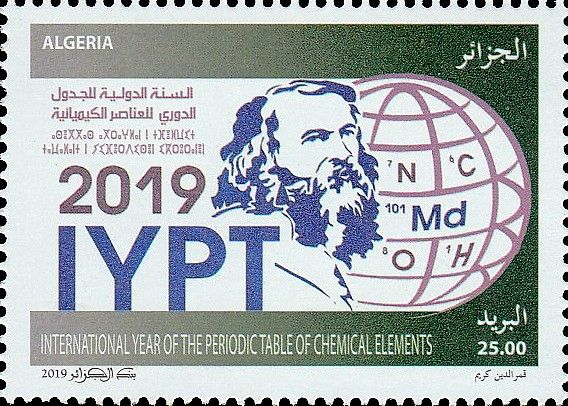
International Year of the Periodic Table of Chemical Elements
The United Nations General Assembly, at its seventy-second session, approved the proposal of the United Nations Educational, Scientific and Cultural Organization (UNESCO), relating to the proclamation of the year “2019, International Year of the Periodic Table of Chemical Elements”.
In its resolution, the UN General Assembly underlined the importance of raising awareness among world opinion on the contribution of chemistry in the promotion of sustainable development and on the solutions that chemistry can still offer to global challenges in various sectors, such as the energy sector, education, agriculture and health, while recalling the contribution in this context, of the main achievements achieved so far thanks to the periodic calendar of the elements.
Furthermore, and to raise awareness among world opinion on the importance of fundamental sciences and in order to further anchor these sciences and perfect their mastery, while emphasizing the improvement of living conditions in developing countries and also, to be able to progress in the future in the field of research and development, the UN General Assembly invited the United Nations Educational, Scientific and Cultural Organization, acting in collaboration with other competent organizations and in the limit of available resources, to play the role of leader during this International Year of the Periodic Table of Chemical Elements.
Definition of the periodic table of chemical elements:
“The Periodic Table of the Elements”, or “Mendeleev Table”, brings together all the known chemical elements, classified according to their number of protons, or atomic number. Elements appearing in the same row or column have similar chemical properties. This table is therefore a particularly important tool in chemistry and in science in general.
The periodic table is used in schools and universities, in addition to scientific research, in order to deduce the characteristics of chemical and physical elements. It is easy for students and researchers to infer results by evaluating the condition of an item. Scientists today explore new elements in order to add them to already existing elements.
Role of the periodic table:
The periodic table of chemical elements makes it possible to define the location of the chemical element in a path/circuit or group, to recognize the electronic constitution of the atom, to define the behavior of the chemical element and to predict the chemical reactions where the element may exist.
In its resolution, the UN General Assembly underlined the importance of raising awareness among world opinion on the contribution of chemistry in the promotion of sustainable development and on the solutions that chemistry can still offer to global challenges in various sectors, such as the energy sector, education, agriculture and health, while recalling the contribution in this context, of the main achievements achieved so far thanks to the periodic calendar of the elements.
Furthermore, and to raise awareness among world opinion on the importance of fundamental sciences and in order to further anchor these sciences and perfect their mastery, while emphasizing the improvement of living conditions in developing countries and also, to be able to progress in the future in the field of research and development, the UN General Assembly invited the United Nations Educational, Scientific and Cultural Organization, acting in collaboration with other competent organizations and in the limit of available resources, to play the role of leader during this International Year of the Periodic Table of Chemical Elements.
Definition of the periodic table of chemical elements:
“The Periodic Table of the Elements”, or “Mendeleev Table”, brings together all the known chemical elements, classified according to their number of protons, or atomic number. Elements appearing in the same row or column have similar chemical properties. This table is therefore a particularly important tool in chemistry and in science in general.
The periodic table is used in schools and universities, in addition to scientific research, in order to deduce the characteristics of chemical and physical elements. It is easy for students and researchers to infer results by evaluating the condition of an item. Scientists today explore new elements in order to add them to already existing elements.
Role of the periodic table:
The periodic table of chemical elements makes it possible to define the location of the chemical element in a path/circuit or group, to recognize the electronic constitution of the atom, to define the behavior of the chemical element and to predict the chemical reactions where the element may exist.