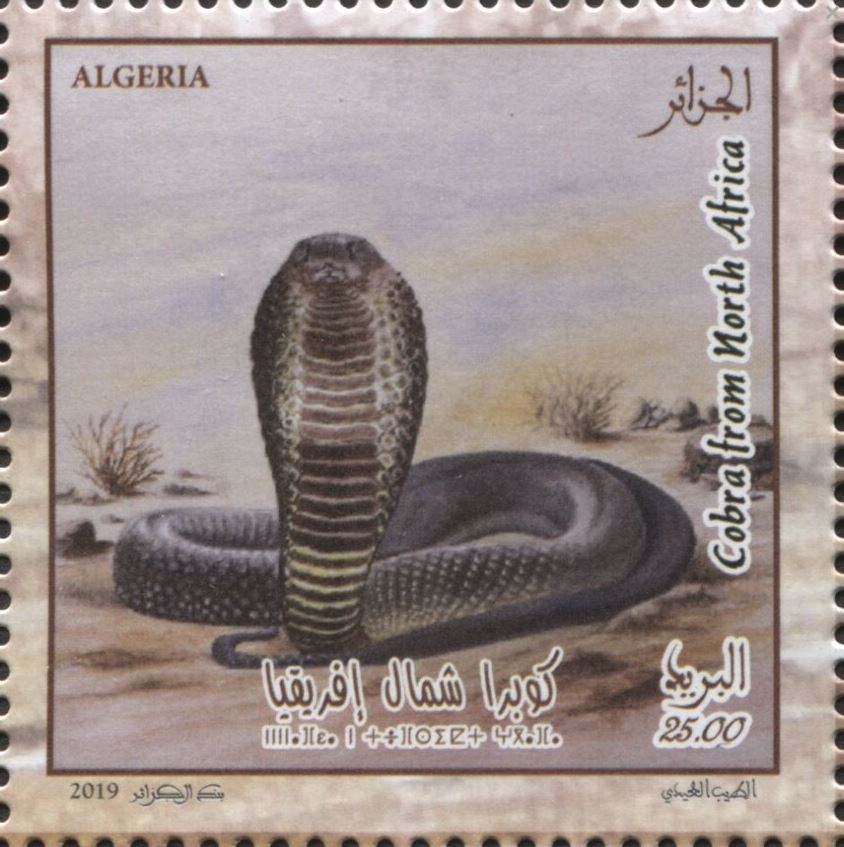
African Cobra
The North African cobra is a species of snake, belonging to the Elapidae family, which has an elongated cylindrical body, and which hardly exceeds 160 cm in length.
In the early stages of life, the small snakes are pale yellow with a brown dotted design throughout the body and head, neck while the forebody is a shiny black color.
This oviparous species is known to lay 8-20 eggs, somewhere under suitable conditions such as in large stone blocks, hollow tree trunks, holes in the ground.
The North African Cobra is considered one of the most endangered species of reptiles in North Africa, particularly in Algeria where it is protected under Executive Decree No. 12-235 of May 24, 2012 establishing the list of protected non-domestic animal species, it only exists in rare places, in general, inhabits arid areas with mild winters, occupying different habitats, flat lands with little vegetation, in much more rugged areas, rocky terrain, and arid wadi beds with no or little vegetation, these snakes are mainly crepuscular and nocturnal, although they have been seen active during the day, particularly in the zibans region.
Adult individuals establish themselves in territories for many years, taking refuge in cracks in walls, rock shelters and abandoned mammal burrows.
The cobra often hunts at dusk in search of prey. Its food spectrum is wide and varied, including: amphibians, frogs, lizards, snakes, birds, small mammals and even eggs.
In Algeria, the species is subject to various forms of pressure, most of which are persistent, requiring a comprehensive conservation and protection strategy through the creation of protected areas.
In the early stages of life, the small snakes are pale yellow with a brown dotted design throughout the body and head, neck while the forebody is a shiny black color.
This oviparous species is known to lay 8-20 eggs, somewhere under suitable conditions such as in large stone blocks, hollow tree trunks, holes in the ground.
The North African Cobra is considered one of the most endangered species of reptiles in North Africa, particularly in Algeria where it is protected under Executive Decree No. 12-235 of May 24, 2012 establishing the list of protected non-domestic animal species, it only exists in rare places, in general, inhabits arid areas with mild winters, occupying different habitats, flat lands with little vegetation, in much more rugged areas, rocky terrain, and arid wadi beds with no or little vegetation, these snakes are mainly crepuscular and nocturnal, although they have been seen active during the day, particularly in the zibans region.
Adult individuals establish themselves in territories for many years, taking refuge in cracks in walls, rock shelters and abandoned mammal burrows.
The cobra often hunts at dusk in search of prey. Its food spectrum is wide and varied, including: amphibians, frogs, lizards, snakes, birds, small mammals and even eggs.
In Algeria, the species is subject to various forms of pressure, most of which are persistent, requiring a comprehensive conservation and protection strategy through the creation of protected areas.