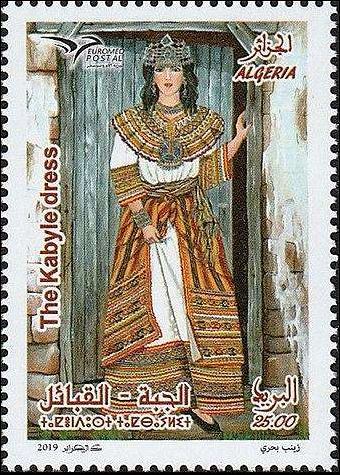
Djebba-kabyle
Traditional outfits date back to ancient times. They have evolved according to the evolution of humanity throughout history and constitute important elements of the cultural heritage of peoples. Each people is distinguished by their traditional dress from the rest of the populations which reflects their link to their history, their heritage and their originality. Traditional clothing is an integral part of the nation's heritage and whatever its improvement or development, it will always retain its values, which do not change across places or times.
Djebba-kabyle:
known as thaquendourth is the basic element of the costume, machine sewn from several pieces, now it can have short or long sleeves or it can be sleeveless. All young women generally have two dresses which hardly differ in shape: the work dress and the ceremonial dress.
The Kabyle dress is made up of:
The apron, called lfoudha, which is an important piece of traditional Kabylian dress. It is a matching fabric that is worn over Thaqendourth tied at the waist.
The belt, called Agous, an essential accessory for women's clothing, is made up of a set of braided multicolored wool threads with pompoms at the ends.
The headdress is made up of a scarf or kerchief, called Tmahremth or amendil, worn on the head, it is an essential piece of women's clothing. The Kabyle woman never leaves him.
Djebba-kabyle:
known as thaquendourth is the basic element of the costume, machine sewn from several pieces, now it can have short or long sleeves or it can be sleeveless. All young women generally have two dresses which hardly differ in shape: the work dress and the ceremonial dress.
The Kabyle dress is made up of:
The apron, called lfoudha, which is an important piece of traditional Kabylian dress. It is a matching fabric that is worn over Thaqendourth tied at the waist.
The belt, called Agous, an essential accessory for women's clothing, is made up of a set of braided multicolored wool threads with pompoms at the ends.
The headdress is made up of a scarf or kerchief, called Tmahremth or amendil, worn on the head, it is an essential piece of women's clothing. The Kabyle woman never leaves him.